

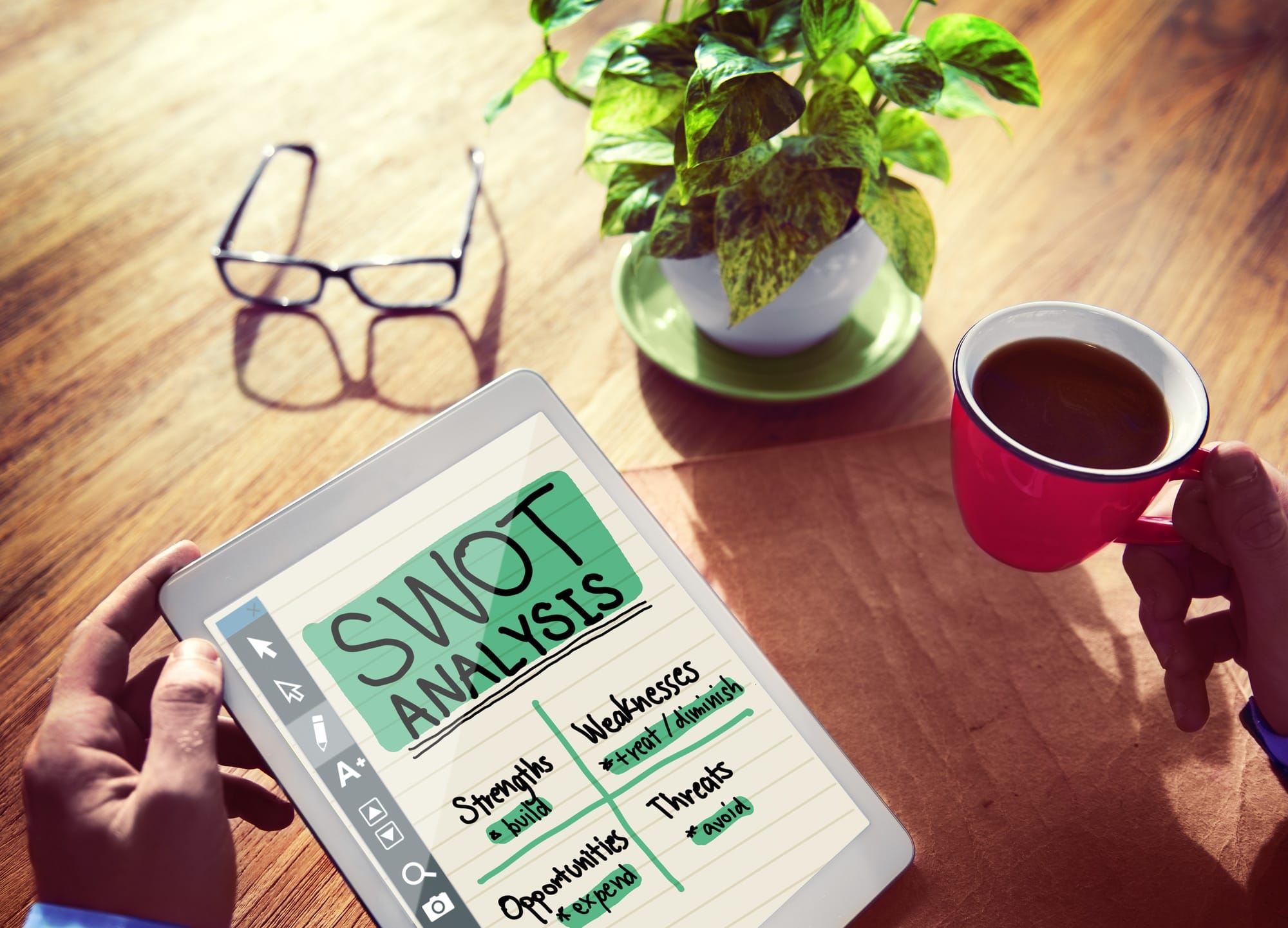
SWOT analysis is essential for more than just business management. You can use it on yourself. In fact, you should use it on yourself, because a business is only as successful as the team behind it.
So how does a personal SWOT analysis work? Instead of looking at the strengths, weaknesses, opportunities and threats of a business, you apply them to yourself. And you start with a goal.
In this guide, I show you how to do a personal SWOT analysis step by step. You get the questions to ask in each quadrant, six worked personal SWOT analysis examples (from a student to a career changer), and the 10 rules that keep the exercise honest.
Quick definition: a personal SWOT analysis lists two internal factors, your Strengths and Weaknesses (things you control, like skills, habits and experience), and two external factors, the Opportunities and Threats around you (things you don't fully control, like the job market, technology and other people). You always do it for one specific goal.
Personal SWOT Analysis at a Glance
| Quadrant | What goes in it | Example questions |
|---|---|---|
| Strengths (internal) | Skills, education, experience, network, personality traits | What do I do better than others? What do people ask me for help with? |
| Weaknesses (internal) | Skill gaps, bad habits, missing credentials, traits that hold you back | What tasks do I avoid? What would my manager say I need to improve? |
| Opportunities (external) | Trends, new tools, people, openings, gaps others ignore | What is changing in my field that I can use? Who can help me? |
| Threats (external) | Competition, changing requirements, money, time, technology | What could stop me? Are the requirements for my job changing? |
Why a Personal SWOT Analysis Matters More Now
Careers move faster than they used to. In its Future of Jobs Report 2025, the World Economic Forum found that employers expect 39% of workers' core skills to change or become outdated between 2025 and 2030, down from 44% in the 2023 edition [1][5]. They also expect 170 million new jobs to be created and 92 million to be displaced over the same period [1]. Put another way: if the world's workforce were 100 people, 59 would need training by 2030 [10].
People also change employers often. In January 2026, the median American wage and salary worker had been with their current employer for 4.1 years, and only 3.0 years for workers ages 25 to 34, according to the US Bureau of Labor Statistics [2]. A separate BLS survey found that Americans born from 1957 to 1964 held an average of 12.9 jobs between ages 18 and 58 [3].
That's a lot of decisions about your career path: what to learn, when to move, and what to say in the next job interview. A personal SWOT analysis gives you a simple, repeatable way to make each one.
Goal Setting Is Essential in a Personal SWOT Analysis
You absolutely need to set a goal before you start doing a SWOT analysis.
Do you want to…
- Start a career in a specific field?
- Be the #1 candidate for that upcoming promotion?
- Get more responsibility from your manager?
- Start a company or product from scratch?
- Make better strategic business decisions?
- Be a better friend, parent or partner?
When you do a personal SWOT analysis, it doesn't have to be directly business-related. You're trying to improve yourself, after all, in all aspects.
And hey, being a better friend or partner will carry over into your working life too. That's the benefit of personal development: personal growth in one area rarely stays in that area.
So, pick one goal. You may have many personal goals, but use one goal per personal SWOT analysis. Otherwise, it gets too complicated, clunky and hard to manage.
A tip: write the goal as one sentence with a date. "Get a UX research job by September 2027" works. "Be more successful" doesn't.
Now, it's analysis time.

Step 1: Start With the Fun Part, Strengths
Strengths (the "S" in SWOT analysis) are the most enjoyable part. List every single thing you do well, and why you do it well.
Pat yourself on the back until your hand hurts.
Then keep track of your strengths. You want everything written down here. You can decide later whether each one matters for your goal.
Your list can include:
- Educational background: Where did you go to school? What did you major in? Which classes can help you reach your goal? (Include internships, apprenticeships and certifications too.)
- Past work experience: List every job you've had and the skills you needed to do each one well. Do the skills overlap? Why did they matter?
- Who do you know? Your network is everything. Is there someone who can help with your goal? References, coworkers or old friends all count as strengths.
- Resources: What do you already have to work with? Savings, free time, tools, a quiet place to study, an employer who pays for training.
- Personality: Which traits will help you reach your goal? Are you outgoing? A good storyteller? Able to get to the point quickly? Do you cringe at being late or missing deadlines?
Your strengths aren't only your own opinion. They include how other people see you. So also ask yourself:
- What advantages do I have compared with other people?
- What do I do better than others?
- What virtues do other people see in me?
- Which accomplishments am I proud of?
Context matters. A strength only counts as a strength relative to your goal and the people around you. Speaking a foreign language won't stand out in a team of translators, where everyone does. But the ability to get along with anyone, and to calm a difficult client, might.


Step 2: The Harder Part, Weaknesses
No one likes to discuss or think about their weaknesses. But this part is crucial, because these gaps are what hold you back from your goal. It doesn't matter how many strengths you have if one weakness is undoing all your progress.
It won't feel good doing this, but it'll help later on.
Going deep on each weak spot is the most important thing. To start, answer:
- What personality traits are lacking to reach your goal? Why?
- What education do you lack?
- Why haven't you reached your goal sooner?
- What negative work habits are holding you back?
- Which tasks do you feel unsure about, and so avoid?
- What blind spots do the people around you see? (Your boss is often the best person to ask.)
- Which habits cost you, such as being late to important meetings, getting distracted or poor time management?
- Where are you at a disadvantage compared with the other people chasing the same goal?
It's important to keep asking "Why?" all through this section.
Since this can be hard, ask others to help out. There's research behind this advice. In a well-known 1999 study, Cornell psychologists Justin Kruger and David Dunning found that participants who scored in the bottom quartile on tests of humor, grammar and logic put themselves around the 62nd percentile, when their scores averaged the 12th [4]. People aren't great judges of their own blind spots. A trusted colleague usually is.
A useful test: where do you hand work to someone else? If you always ask a coworker to present when persuasion or public speaking is needed, weak communication skills belong on your list.
And remember, you're doing this to remove the obstacles in your way.
Step 3: Do Threats Before Opportunities
My recommendation: it's smarter to answer threats before opportunities. By doing threats first, you can quickly find "opportunities" that remove or reduce each threat.
You basically kill two birds with one stone.
Threats can be fears that stop you from reaching your goal.
If you're looking to switch career fields, you may have several threats (fears), such as:
- Lack of education to make the switch
- Competition (applying for jobs against people with 10+ years of experience)
- Lack of funds, or a lower income during the switch
How do you combat these threats, or turn them into opportunities?
- Find reliable sources, blogs or textbooks to fill the education gap, and keep up with industry trends and news online.
- Talk to people in the field and ask for advice. They may point you in the right direction or give you an "in" at a company.
- Save up before making the switch (if possible) to cover any time without work.
As you can see, it's easier to find opportunities after picking through the threats.
Okay, your goal may not be to change fields. That's fine. Here are other questions for the threats list of your SWOT analysis template:
- Are people trying to stop you from reaching your goal? Do you know why?
- Is money an issue? How so?
- Is location or transportation an issue?
- Are there not enough hours in the day? If so, what can you move around? (Time management problems often show up here first.)
- Are the requirements for you or your work changing?
- Is technological progress a problem for your profession? (With AI tools spreading through most office jobs, this question belongs on almost every list in 2026.)
- Do you have serious competitors for the same role, client or place?
- Are your own gaps a threat to success?
- Do you have the resources (money, time, support) to see the goal through?
Study potential threats early, so you can deal with them in time, or stop them from appearing at all.
Step 4: And the Final Part, Opportunities
Opportunities are things you create or act on to reach your goal. Many people see opportunities as external factors you can't control, but that's not entirely true. Once you've identified the threats in your personal SWOT analysis, you can create opportunities to counter them.
What other opportunities exist?
- Technology: Which tools can help you reach your goal? You may need to-do lists, email, texting, online courses or even online marketing. What data can you find online?
- People: Going back to those contacts, who can you network with? List what you get from each relationship.
- Competition: Who is your competition? Where are they failing? What are they ignoring? How can you use this to your advantage?
- Trends: What changes do you see coming in your field, and which ones play to your strengths?
- Problems to solve: What problems do your manager, clients or partners have? Solving one of them is often the fastest opportunity of all.
Always look at your strengths together with the opportunities they can open. And build new strengths through workshops and courses. For example, you can practice cognitive skills such as memory, attention and reasoning with games designed for it.
Your list of opportunities doesn't need to be long. It needs to be specific enough that you can act on each item this month. The people who get the most from a personal SWOT are the ones who take advantage of opportunities quickly, before others spot them.
Once opportunities are done, you've finished the personal SWOT analysis.

Personal SWOT Analysis Questions (Cheat Sheet)
There are lots of SWOT question lists available. This is the list of questions I use for a personal SWOT:
| Strengths | Weaknesses |
|---|---|
| What are my assets (skills, degrees, experience)? | Which areas do I need to improve? |
| What do others say I'm good at? | Which tasks do I avoid, and why? |
| What have I achieved that I'm proud of? | Which habits cost me time or trust? |
| Who in my network can vouch for me? | What would a blunt friend say holds me back? |
| Opportunities | Threats |
|---|---|
| What external changes could help me? | What negative trends affect my field? |
| Which new tools or courses could I use? | Are the requirements for my role changing? |
| Who could open a door for me? | Who am I competing with? |
| What problems can I solve for others? | Could money, time or location stop me? |
6 Personal SWOT Analysis Examples
Here are six worked personal SWOT analysis examples. The people are illustrative composites, not real individuals, but each one follows the method above: one goal, an honest list, and then actions.
Example 1: College student looking for a first internship
Maya, 20, sophomore marketing major. Goal: land a paid marketing internship for summer 2027.
| Strengths | Weak spots |
|---|---|
| Runs the social accounts of her campus club (follower growth she can show) | No formal work experience |
| Strong writer; A grades in two writing-heavy classes | Nervous in interviews |
| Comfortable with Canva and basic video editing | Hasn't used any analytics tool |
| Organized; never misses a deadline | Small professional network; time management slips during exams |
| Opportunities | Threats |
|---|---|
| Career fair in February | Hundreds of applicants for the same roles |
| Alumni from her school working at local agencies | Many internships are unpaid |
| Free online analytics certifications | Interviews often include a skills test |
| Local small businesses that need social media help | Part-time job limits her free time |
What she does next. Maya turns her club work into a one-page case study with real numbers. She completes a free analytics course before the career fair (an opportunity that fixes a weakness), and she does two mock interviews at the campus career center. For more student versions, see my SWOT analysis examples for students.
Example 2: Employee going for a promotion
James, 31, software engineer. Goal: be promoted to team lead within 12 months, the next step in his career growth.
| Strengths | Weak spots |
|---|---|
| Deep knowledge of the company's main codebase | Avoids conflict; struggles to give hard feedback |
| Trusted by teammates; mentors two juniors | Rarely presents to senior managers |
| Strong delivery record on two big releases | Weak at estimating timelines |
| Opportunities | Threats |
|---|---|
| A team lead plans to leave next spring | Two peers want the same role |
| Company offers a paid leadership course | A reorganization could merge teams |
| His manager wants someone to run sprint planning | AI coding tools change what "senior" means |
What he does next. James volunteers to run sprint planning (a low-risk way to practice leading). He signs up for the leadership course, and he asks his boss for a monthly feedback check-in. His weakness with conflict goes on his tracking sheet, with one hard conversation per month as the target. I also wrote an employee SWOT example, a workplace version of this exercise.
Example 3: Career changer
Priya, 38, high school teacher. Goal: move into instructional design by the end of 2027.
| Strengths | Weak spots |
|---|---|
| 12 years of lesson planning and curriculum design | No portfolio of corporate training work |
| Explains complex ideas simply | Unfamiliar with e-learning software |
| Calm under pressure; manages 30 people at once | Has never worked in a corporate setting |
| Opportunities | Threats |
|---|---|
| Companies that need training for new AI tools | Pay cut in the first role |
| Former teachers already in the field who can advise her | Competition from people with corporate experience |
| Online courses and free trials of authoring tools | Summer is her only real time to job-hunt |
What she does next. Because she did threats first, Priya sees that the pay cut is the threat most likely to stop her. She sets a savings target before she applies. She builds three portfolio pieces by turning her best lessons into short online modules, and she asks two former teachers who made the switch for a 20-minute call each.
Example 4: Recent graduate preparing for interviews
Luis, 23, finance graduate. Goal: get an analyst job offer within six months.
| Strengths | Weak spots |
|---|---|
| Strong Excel and modeling skills | Freezes on "Tell me about a weakness" in a job interview |
| Internship at a regional bank | Long, unfocused answers |
| Bilingual (English and Spanish) | Few people in finance to ask for referrals; communication skills need polish |
| Opportunities | Threats |
|---|---|
| Banks hiring bilingual staff for Latin American clients | Large firms have fewer entry-level openings |
| University alumni database | Automated screening filters out generic resumes |
| Mock interview tools | Interviews include case questions he hasn't practiced |
What he does next. Luis uses his SWOT as interview prep. His strengths become his three talking points. His answer to the weakness question is real but already being fixed ("I used to give long answers, so I now practice with a timer"). And his bilingual skills point him to a specific type of employer. That's one of the most practical uses of a personal SWOT: you prepare honest answers to tricky interview questions before anyone asks them.
Example 5: Freelancer growing a small business
Ana, 29, freelance graphic designer. Goal: double her number of retainer clients by the end of 2027.
| Strengths | Weak spots |
|---|---|
| Distinctive style; strong portfolio | Undercharges; no clear pricing |
| Fast turnaround | No sales process; relies on referrals |
| Happy clients who would give testimonials | Admin and invoicing pile up |
| Opportunities | Threats |
|---|---|
| Local businesses refreshing their brands | AI image tools pushing prices down for simple work |
| Partnerships with web developers | One client is 40% of her income |
| Packaged "brand kits" she can sell | Late payments |
What she does next. Ana sees that her biggest threat (one client making up 40% of her income) and her biggest weakness (no sales process) are connected. She sets up a simple monthly outreach routine, asks three clients for testimonials, and launches a fixed-price brand kit. To counter cheap AI tools, she sells strategy and consistency rather than one-off images.
Example 6: Personal life goal
David, 45, works full time with two kids. Goal: run a half marathon in October 2027.
| Strengths | Weak spots |
|---|---|
| Disciplined at work; good with routines | Out of shape; old knee injury |
| Supportive partner | Stress eating late at night |
| Lives near a park with a running loop | Gives up when progress is slow |
| Opportunities | Threats |
|---|---|
| A local running club with beginner groups | Work travel breaks his routine |
| Free training plans and running apps | Kids' activities fill weekends |
| A coworker who wants to train too | Injury if he increases distance too fast |
What he does next. David books a checkup for his knee before starting, so a weakness doesn't turn into a threat. He trains with his coworker for accountability and joins the club's beginner group. And he plans short hotel-gym workouts for work trips. Remember the goal list at the start: a personal SWOT analysis works just as well outside your career.
For business versions of the same exercise, see my SWOT analysis examples.
Turn Your Personal SWOT Into a Plan
A personal SWOT analysis isn't finished when the four boxes are full. The value comes from matching them and turning the matches into an action plan. That's the idea behind the TOWS analysis, and it works for people as well as companies:
- Strengths + Opportunities: use what you're good at to grab an opening (Maya's club case study at the career fair).
- Weaknesses + Opportunities: use an opening to fix a weakness (James running sprint planning).
- Strengths + Threats: use a strength to blunt a threat (Ana selling strategy, not just images).
- Weaknesses + Threats: the danger zone. Fix these first (Priya's savings target before the pay cut).
Write each match as one action with a deadline, and you have a one-page action plan you can keep on your desk.
There's also an article published on Business Analyst Guru that gives a step-by-step guide to this kind of SWOT analysis with a working example, and it explains the benefits of completing your own personal SWOT analysis. Its author shares the following 10 rules.
10 Rules to Follow in a Personal SWOT Analysis
These are the ten core principles (or rules) that you MUST keep in mind while you complete your personal SWOT analysis.
Ignoring them could be disastrous. It could mean more of your time is wasted than used well. It doesn't matter whether you're a marketer, a business analyst or just improving your personal circumstances. No one wants to waste their own time.
So follow these, and I promise you'll come out on top.
1. Give yourself a purpose
Whoever you are. Whatever you do.
The first thing you need is a goal or a target. It could be a new job, a new project, or even just a year out traveling.
With a goal, you can focus your efforts and answer the right questions when you fill in the four quadrants.
Your goal gives the personal SWOT analysis a purpose, and a person with a purpose is almost certainly a person with conviction.
And conviction will help you get results. Honest.
2. Come up with as many questions as possible
Some say life begins with a question, and that it's your answers that help you thrive.
I won't get into that debate now, but a personal SWOT analysis definitely needs questions. Lots of them, and you have to answer them yourself.
Here are some simple examples:
- S: What are my assets?
- W: Which areas do I need to improve?
- O: What external changes will bring me opportunities?
- T: What are the negative trends in my area of interest?
These are just the simplest examples. You need to ask a lot more questions than this. The world is your oyster, so think outside the box when you write your own.
3. Ask others
This may seem to contradict the previous rule.
Yes, I did say that YOU need to answer the questions. But that doesn't mean you can't get guidance from the people around you.
That could be loved ones (be careful, they might just tell you what you want to hear), colleagues, friends, or even people you've only met once or twice.
Think carefully about what they say. It could help you answer many of the questions in a different way.
4. Don't be afraid to admit your weaknesses
This is key.
One of the hardest interview questions is "What's your weakness?" But you're not in an interview, so you can be harsher with yourself here.
They CAN be flaws you wouldn't necessarily admit to a future employer. Knowing your blind spots fully is arguably the first step to improving your situation. The bottom line is this:
Be true to yourself and you WILL succeed.
5. Don't duplicate (a weakness can't be a strength too)
This happened to me, and I had to fix it. It may not happen to you, but I still think you should be aware of it.
When you get absorbed in the work, you may get carried away filling in the four boxes. In doing so, you could list similar things as both a weakness AND a strength.
So filtering out duplicate statements across the sections is hugely important. A weakness can't also be a strength, and a threat can't also be an opportunity.
Sounds obvious, doesn't it? But keep a lookout anyway.
6. Threats before opportunities
Most guides tell you to look at opportunities first and threats second. This is where I throw a wrench in the works and get a bit controversial.
I was once told to look at my threats before my opportunities. And I have to say, it was great advice. I've never gone back.
Looking at threats first can help you spot new opportunities you might never have thought of otherwise. For example:
- Threat: changes in the industry could leave me behind.
- Opportunity: use blogs, books and social media to keep up with new industry standards.
So go on, do it, and see what happens.
7. Take action
This is the whole point of a personal SWOT analysis: to take real action in real life, improve your skills and update the way you think.
So don't just do it and think "it's DONE." It's NOT.
Make sure you keep improving and keep working on all four quadrants.

8. Monitor your personal SWOT analysis progress
This is my favorite.
I firmly believe that anyone who wants something out of a personal SWOT analysis must follow this rule. Take all your findings from the four quadrants and put them in a spreadsheet. Give yourself a target for each one you want to change.
Take action.
Then revisit the spreadsheet every 2 to 3 months.
9. Keep updating it
You may think: isn't this the same as monitoring my progress?
No, it's not.
By monitoring, I mean following up on what you've already found out about yourself. By updating, I mean finding new things out about yourself.
New opportunities can come up at any time, and new gaps can become more damaging. If you don't know about them, you can't do anything about them.
So redo your personal SWOT analysis every 6 to 12 months, and add the new findings to the spreadsheet from rule 8.
10. Don't procrastinate
This rule applies to everything in life, but I still want to mention it.
Don't put your personal SWOT analysis off until tomorrow. What if tomorrow never comes? Do it now: today, this hour, this minute.
Either get started with this post, or if you know what you're doing, simply go for it.
Can AI Help With a Personal SWOT Analysis?
Yes, as a sparring partner, not as the author. An AI assistant such as Grok can suggest questions you didn't think of, challenge vague entries ("good communicator" — compared with whom?), or role-play a tough interviewer who probes your weaknesses.
But it can't know your habits, your relationships or what you really want. So write your own first draft, then use AI to stress-test it. And keep the private parts private: don't paste in anything you wouldn't want stored.
Personal SWOT Analysis Complete: Now What?
Your personal SWOT analysis shows the strengths you need to reach your goal. These are your competitive advantages. They're what help you stand out, and every business and every person should know their advantage in any situation.
Pick 3 major strengths that will most affect how and when you reach your goal. Highlight them in cover letters and elevator pitches, wherever they help you get there.
Keep these strengths in mind as you move on to your weak spots.
With your gaps written into your SWOT analysis, rate them. Which one is really holding you back? Which ones are annoying but minor? Root out the weaknesses with the biggest impact, and make a plan to counter them.
Now look at your threats. Hopefully, you found an opportunity for each one. Those opportunities will push you into action. They're the small steps toward your goal.
Keep your eye on those weak spots and track your steps toward the goal, and you'll be in good shape.
Treat the finished page as a compass you recalibrate, not a report card you frame.
Whatever your goal, you're now on track to reach it.
What People Are Saying on X
People who try this tend to agree on one thing: the weak-spots quadrant is where the value is.
One user said they ran a SWOT analysis on themselves to tackle her "emotional/cognitive blindspots," and that a friend "looked at me so crazy" for it. The verdict: "It helps to see yourself from the outside then take actions to correct certain behaviors/beliefs." That's rule 3 in action.
Lonita (@LonitaMusic) summed up what her personal SWOT showed her: "the magic is in the work you're avoiding. Do it now." That's rules 4 and 10 in one line.
And Ayush (@theayush) joked about the classic mistake: "Did a SWOT analysis of myself / Only strengths and opportunities / No weaknesses or threats." Funny, and exactly the version that doesn't work.
My friend looked at me so crazy when I said that I did a SWOT analysis on myself to strengthem/eliminate my emotional/cognitive blindspots, but I swear It helps to see yourself from the outside then take actions to correct certain behaviors/beliefs.
— 🌻 (@vlvtrse_) March 12, 2026
I just did a SWOT analysis on myself and all I can say is the magic is in the work you’re avoiding.
— SUPERSTAR (@LonitaMusic) August 30, 2026
Do it now.
Did a SWOT analysis of myself
— Ayush Sharma (@theayush) January 30, 2026
Only strengths and opportunities
No weaknesses or threats pic.twitter.com/VGSgDgdg5f
FAQ
What is a personal SWOT analysis?
It's a self-assessment that lists your strengths and weaknesses (internal) and the opportunities and threats around you (external), all measured against one specific goal, such as a new job, a promotion or a personal project.
What are some examples of threats in a personal SWOT analysis?
Common threats include strong competition for the same role, job requirements that are changing, new technology (such as AI tools) that automates part of your work, lack of money or time, an unsupportive environment, and your own weaknesses if you leave them unchecked.
How do you identify your strengths for a SWOT analysis?
Combine your own view with other people's. List your skills, education, experience, network and personality traits. Then ask colleagues or friends what they think you do best, and look at what people regularly ask you for help with.
How do I write a personal SWOT analysis as a student?
Use one academic or career goal, such as an internship, a scholarship or a grade target. Students' strengths are often class projects, clubs and part-time jobs. Weaknesses are often experience and networks. See Example 1 above and my SWOT analysis examples for students.
How do I use a personal SWOT analysis in a job interview?
Use your top three strengths as talking points, and prepare one honest weakness that you're already fixing (Luis does this in Example 4). If the interviewer asks about your career path, your opportunities list shows you've thought about where your field is going.
Can a personal SWOT analysis help with career growth?
Yes. Share a short version with your boss and ask what's missing. It turns a vague "I want to grow" into specific skills, certifications or projects you can agree on, which is much easier to support.
How often should I update my personal SWOT analysis?
Check your progress every 2 to 3 months, and redo the whole analysis every 6 to 12 months, or whenever your goal changes.
Sources
- World Economic Forum, "Future of Jobs Report 2025: 78 Million New Job Opportunities by 2030 but Urgent Upskilling Needed to Prepare Workforces," 8 Jan 2025
- US Bureau of Labor Statistics, "Employee Tenure in 2026," 24 Sep 2026
- US Bureau of Labor Statistics, "Number of Jobs, Labor Market Experience, Marital Status, and Health for those Born 1957-1964," 26 Aug 2025 (reissued 21 Jul 2026)
- Kruger, J. and Dunning, D., "Unskilled and unaware of it: How difficulties in recognizing one's own incompetence lead to inflated self-assessments," Journal of Personality and Social Psychology, 1999 (PubMed)
- World Economic Forum, "The Future of Jobs Report 2025: 3. Skills outlook," Jan 2025
- Business Analyst Guru, "The Personal SWOT Analysis: FREE Template & How to guide" (Wayback Machine copy, 12 Aug 2026)
- @vlvtrse_, post on X, 12 Mar 2026
- Lonita (@LonitaMusic), post on X, 30 Aug 2026
- Ayush (@theayush), post on X, 30 Jan 2026
- World Economic Forum, "Future of Jobs Report 2025" (PDF), Jan 2025


