

If you are reading this on an iPhone, iPad or Mac, you are already part of the story. Apple Inc. sells hardware, software and services as one system, and that is exactly why it is such a useful company for a SWOT analysis. Apple Inc. is also the company most people picture when they think of premium smartphones. Its strengths are easy to see. Its weaknesses are often the same strengths viewed from another angle.
In this Apple SWOT analysis, I look at Apple's strengths, weaknesses, opportunities and threats as they stand in November 2026. For the outside forces (tariffs, regulation, climate rules and the rest), see my Apple PESTLE analysis.
Update (November 18, 2026): I rewrote this page for 2026. The earlier version still talked about a 2024 market value, Covid lockdowns and the war in Ukraine as Apple's main threats. I also added the outage of Tuesday, November 17, 2026, when iCloud sign-in, Apple Pay, the App Store and Apple Music went down for several hours. Apple blamed an internal update and ruled out a cyberattack.
In short: Apple's strengths are a strong brand, an integrated ecosystem of more than 2.5 billion active devices, a fast-growing Services business and huge profits. Its weaknesses are its reliance on the iPhone, expensive products, a late start in generative AI and a services model that depends on always-on systems. Its opportunities are AI features on its own devices, India, health, and wearables and spatial computing. Its threats are regulation and antitrust cases, intense competition, trade policy and supply-chain risk, including natural disasters.
Apple Overview
Steve Jobs, Steve Wozniak and Ronald Wayne founded the Apple Computer Company as a partnership on April 1, 1976. Wayne pulled out eleven days later, and the company incorporated in January 1977, according to the Computer History Museum. The garage story is famous. What matters for this analysis is what came after it.
Jobs left in 1985, came back in 1997 and simplified the product lines. Then came the run of innovative products that built Apple's success: the iPod in 2001, the iPhone in 2007, the iPad in 2010 and the Apple Watch in 2015. Tim Cook took over as CEO in 2011. On August 2, 2018, Apple became the first company to reach a market value of $1 trillion. When it turned 50 in 2026, the LA Times called it a "$3.5-trillion titan."
The leadership changed again this year. On April 20, 2026, Apple announced that John Ternus, its hardware engineering chief, would become CEO on September 1, 2026, with Tim Cook moving to Executive Chair. Apple is still headquartered in Cupertino, California.
Apple at a Glance (Fiscal 2026)
Apple's fiscal year ends in late September. These figures come from its annual report for the year ended September 26, 2026.
| Metric | FY2026 | Change vs FY2025 |
|---|---|---|
| Net sales | $478.8 billion | +15% |
| iPhone | $254.1 billion (53% of sales) | +21% |
| Services | $123.3 billion | +13% |
| Mac | $37.9 billion | +13% |
| iPad | $27.9 billion | flat |
| Wearables, Home and Accessories | $35.6 billion | flat |
| Greater China | $82.4 billion | +28% |
| Gross margin | 48.8% (Products 39.3%, Services 76.2%) | +1.9 points |
| Net income | $132.2 billion | +18% |
| Research and development | $45.8 billion (10% of sales) | +32% |
Apple Strengths
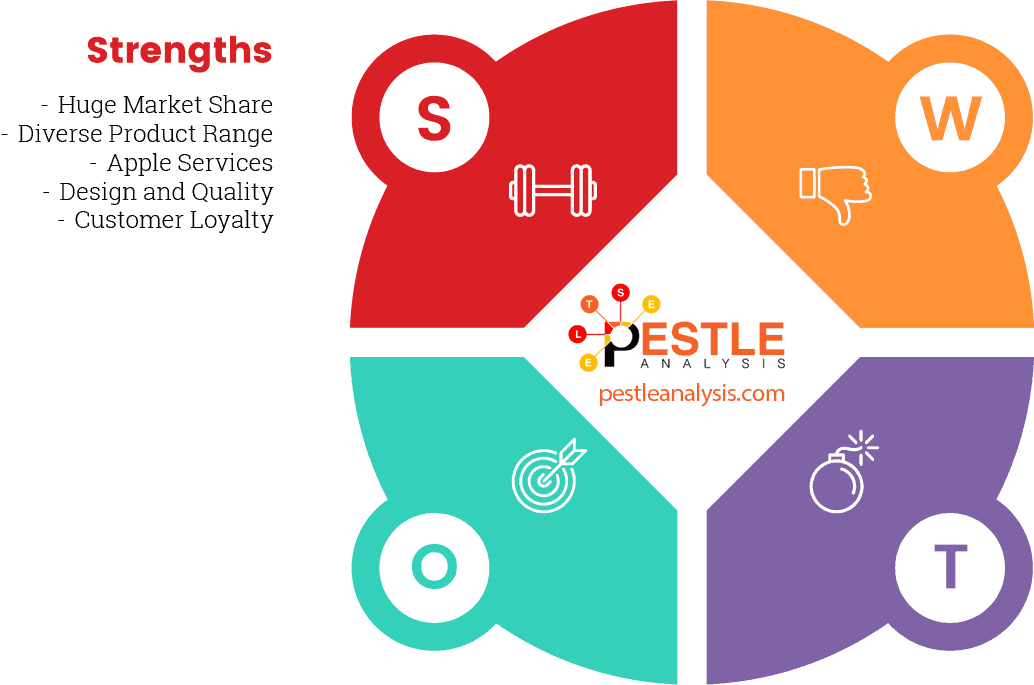
Strengths are the things a company does better than its rivals. For Apple, most of them come back to one idea: it controls the whole experience.
1. A Strong Brand and Brand Loyalty
Apple has one of the strongest brands in consumer electronics. A strong brand image lets Apple charge more than most manufacturers and still sell in huge volumes. Apple itself credits "very high levels of customer satisfaction and loyalty" for its installed base.
Brand loyalty is not just emotion, though. It is also habit. Once your photos, messages, passwords and payments live in Apple's system, switching to another brand of smartphones takes real effort. That is the kind of loyalty I count as a strength: it shows up in the numbers every year.
2. The Apple Ecosystem and Hardware-Software Integration
Apple designs the chips, the hardware, the operating systems and many of the services that run on them. That integration is why an iPhone, Mac, iPad and Apple Watch work together so smoothly, and why the user experience feels consistent from one device to the next.
The size of the Apple ecosystem is the best proof. Apple reported more than 2.5 billion active devices in January 2026. Each device makes the next Apple purchase a little more likely, and each one is a customer for Services.
3. Services: The Second Engine
Services (the App Store, iCloud, Apple Music, Apple TV, AppleCare, advertising, Apple Pay and more) brought in $123.3 billion in fiscal 2026, up 13%. More importantly, Services earned a 76.2% gross margin, against 39.3% for products.
That margin gap is at the heart of Apple's business model. Apple sells the device once, then earns from it for years. Thus, Services makes Apple less dependent on how many smartphones it sells in a given quarter.
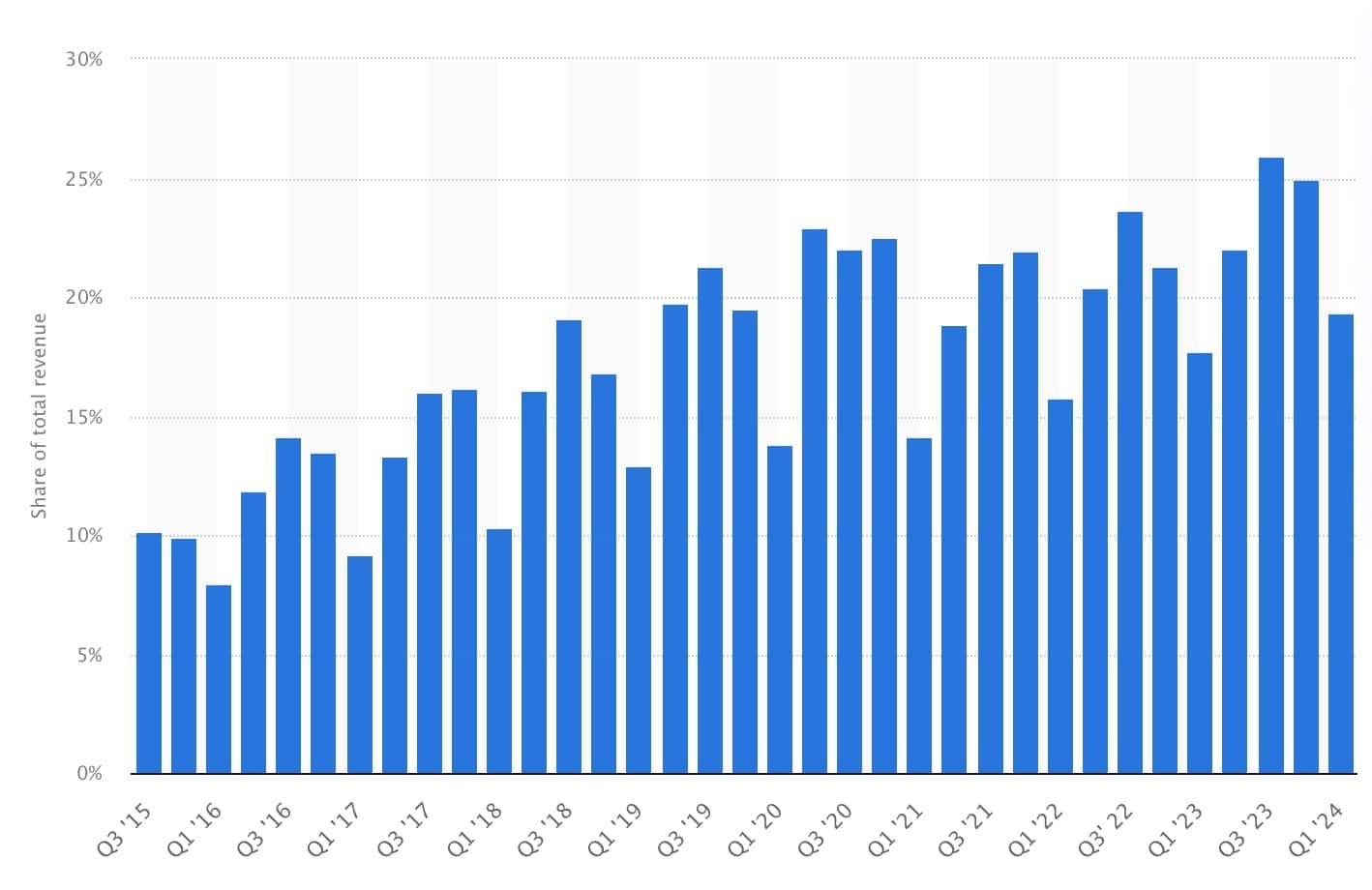
Revenue from services as a share of Apple's total global revenue, 2015-2024 (Source: Statista). In fiscal 2026, Services was about 26% of net sales.
4. Financial Strength
Apple made $132.2 billion in net income on $478.8 billion of sales in fiscal 2026. That kind of profit pays for a lot: $45.8 billion of research and development, its own chip designs, a global retail network and the legal battles described below. Few companies can fund innovation and fight regulators at the same time without feeling it. Apple can.
5. Design, Quality and Custom Silicon
Apple's products are known for simple design and high build quality. Since the switch to Apple silicon in 2020, Macs have also had a performance and battery-life story to tell, and Mac sales grew 13% in fiscal 2026 on higher sales of laptops. In February 2025, Apple added the C1, "the first modem designed by Apple." Owning more of the chips means more control over cost, battery life and the timing of new features.
6. Product Lines That Cover the Whole Day
Apple's product lines now cover most of a person's day: iPhone, Mac, iPad, Apple Watch, AirPods, Apple TV, HomePod and Apple Vision Pro. In fiscal 2026, Apple sold $37.9 billion of Macs, $27.9 billion of iPads and $35.6 billion of wearables, home products and accessories. Those categories are small next to the iPhone, but each one is a bigger business than many entire companies.
Apple Weaknesses
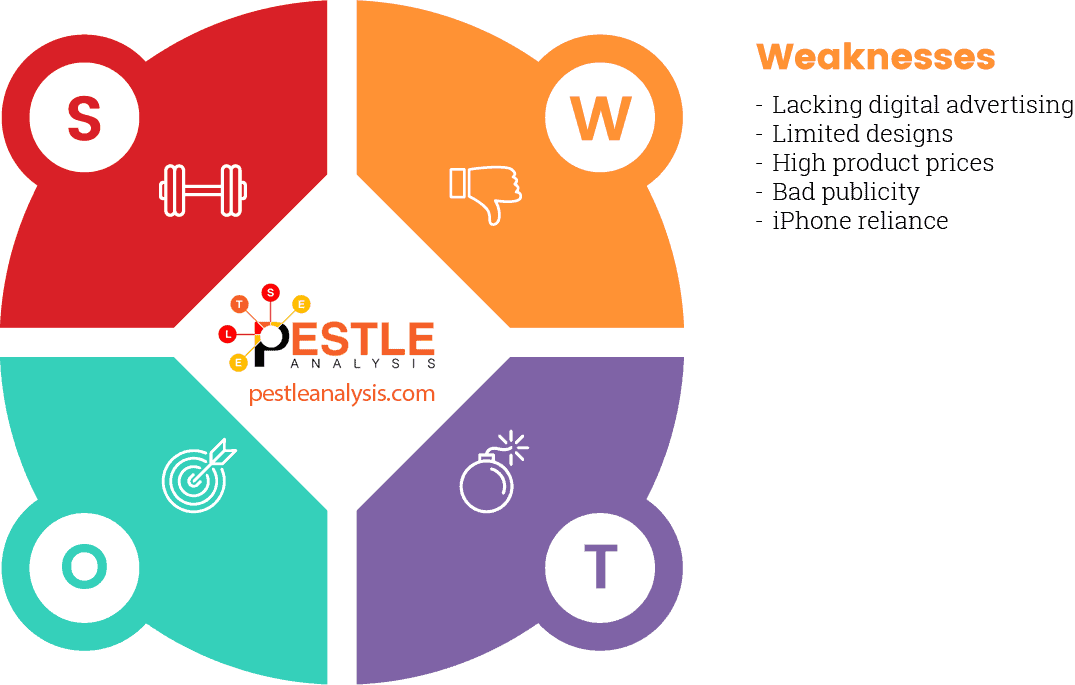
Weaknesses are internal limits. Apple's biggest weaknesses are the price of its success.
1. Reliance on the iPhone
The iPhone brought in $254.1 billion in fiscal 2026, 53% of net sales, up from 50% a year earlier. The iPhone is a wonderful business. Nevertheless, when more than half of your revenue comes from one product line, one weak cycle, one failed design or one trade dispute hits the whole company. Much of Services also depends on iPhone owners.
2. Expensive Products and a Premium Pricing Strategy
Apple's premium pricing strategy works in rich markets. iPhone growth in fiscal 2026 came from "higher net sales of Pro models," Apple says. But expensive products limit Apple's reach in price-sensitive countries, and Apple admits that its own price increases "may also reduce demand." In a period of rising memory costs, the pressure to raise prices again is real.
3. A Late Start in Generative AI
This was Apple's most visible weakness of the last two years. In 2025, Apple delayed its more personal Siri, saying "it's going to take us longer than we thought." On January 12, 2026, Apple and Google announced that the next generation of Apple's foundation models "will be based on Google's Gemini models and cloud technology."
Apple says Apple Intelligence still runs on its devices and on its Private Cloud Compute, so the privacy story survives. Mind you, relying on a rival for a key layer of AI is a strategic weakness for a company that built its success on owning the whole stack.
4. A Minority Market Share
Apple sells more profitable devices than anyone, but not the most devices. Its annual report says it has "a minority market share in the global smartphone, personal computer, tablet and wearables markets." That matters because developers may give priority to platforms with larger market share. Apple's loyal users make up for it in rich markets; in emerging markets, the gap is harder to close.
5. Products Built to Work Best Together
Integration is a strength, but it has a downside. Many Apple features work best, or only, with other Apple products. That limits Apple's appeal to people who mix brands, and it is exactly the behavior regulators now question (see the threats below).
6. Dependence on Always-On Cloud Services
The Apple Account that keeps users loyal also makes them depend on Apple's servers. On Tuesday, November 17, 2026, an outage hit iCloud sign-in, Apple Pay, the App Store, Apple Music and Apple's retail systems. Apple said "an internal update caused some outages," ruled out a cyberattack, and told CBS News that services were "green across the board" by about 5:46 p.m. US Eastern time.
Why do I count this as a weakness and not a one-off? Because the value of Services depends on being available all the time. When iCloud sign-in fails, an iPhone can ask for your password again, some users couldn't activate a new iPhone, and customers in Apple Stores couldn't complete purchases, according to TechCrunch and MacRumors. Downdetector counted around 2,300 US reports for Apple Pay and 1,800 for iCloud at their peaks, Reuters reported. Those numbers are small next to Apple's user base, but payments are where trust breaks fastest.
The timing made it worse. The outage came in a week of disruptions at Microsoft, US banks, the FAA and the NSA, so many users suspected a cyberattack before Apple explained. Apple's quick statement limited the damage. Nevertheless, reliability is now part of Apple's privacy-and-security brand, and an internal update can hurt that brand as much as a hacker can.
Apple Opportunities
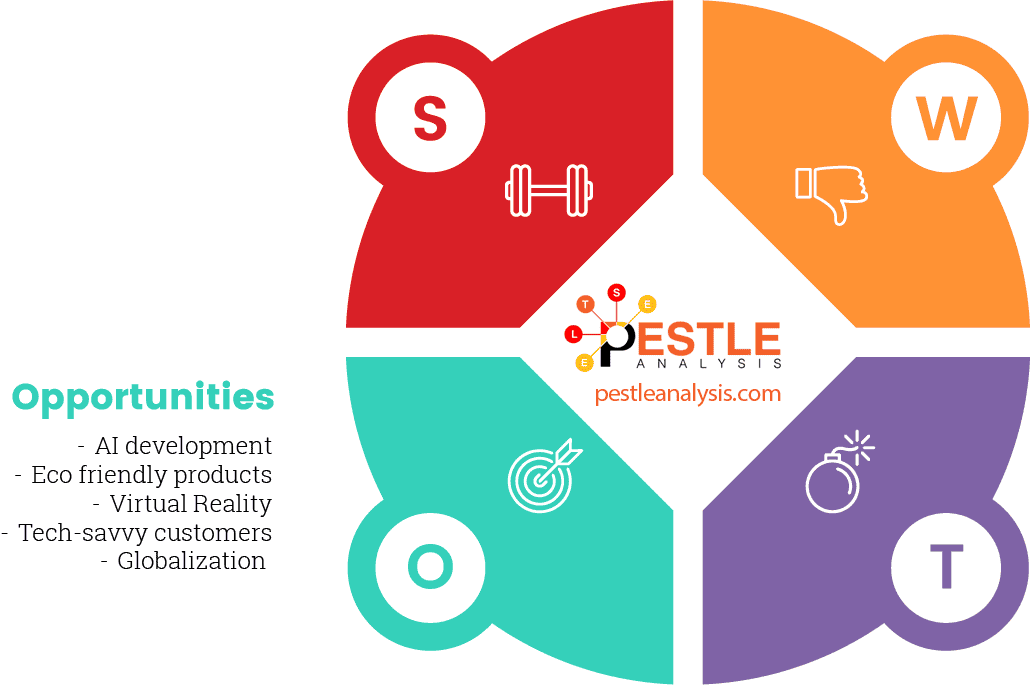
Opportunities are openings in the market that a company can use.
1. AI on the Device
Apple is late in AI, but it has something its rivals don't: billions of devices with its own chips in them. If useful AI features run on an iPhone or Mac, privately and without an extra subscription, that can become a reason to upgrade. Apple's research and development spending rose 32% in fiscal 2026, "primarily due to higher infrastructure-related costs, including investments in artificial intelligence." The money is there. The question is execution. For the wider AI picture, see my SWOT analysis of artificial intelligence.
2. India and Other Growth Markets
India is both a factory and a market for Apple. By March 2026, Apple was making about a quarter of its iPhones in India, Bloomberg reported. A larger local footprint can lower trade risk and help Apple sell to India's growing middle class. Apple does not report Indian sales separately, so I treat this as an opportunity in progress, not a proven result.
3. Health and Wearables
The Apple Watch and AirPods are turning into health devices. In September 2024, the US FDA authorized Apple's Hearing Aid Feature for AirPods Pro, the first over-the-counter hearing aid software. Health is a strong reason to stay in the Apple ecosystem, because the data and the habits build up over years.
4. Spatial Computing, AR and VR
Apple Vision Pro launched in February 2024 at about $3,500. Augmented reality and VR are still small markets, and the reviews were mixed. Still, Apple has a habit of entering a category late and expensive, then making it mainstream. If the price comes down and the apps come in, spatial computing could become the next category in Apple's product lines.
5. New iPhone Designs
For years, the most common complaint about the iPhone was that each model looked like the last. In its fiscal fourth quarter, Apple launched the iPhone Duo, which John Ternus called "the most transformational iPhone since the original." New form factors give loyal users a reason to upgrade sooner, and that is how consumer preferences can work in Apple's favor.
6. Services Beyond the App Store
Apple grew Services in fiscal 2026 mainly through "advertising and cloud services." Payments, subscriptions and enterprise device management can grow alongside them. Every new service that works only inside the Apple ecosystem adds to the switching cost, which brings me to the threats.
Apple Threats
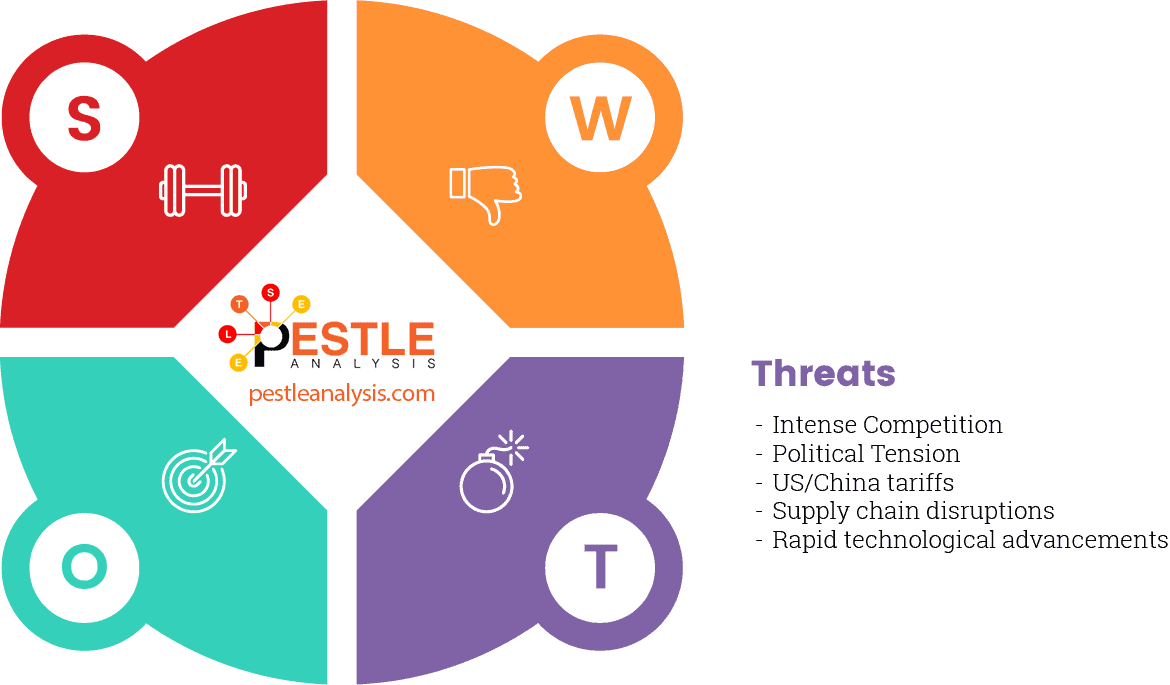
Threats are external factors that could hurt a company. Apple faces fewer threats to its demand than to its business model.
1. Regulation and Antitrust Cases
Regulators on both sides of the Atlantic are going after the App Store and the iPhone's closed design. On April 23, 2025, the European Commission found Apple in breach of the Digital Markets Act and fined it €500 million. In the US, a federal court denied Apple's motion to dismiss the Justice Department's antitrust lawsuit on June 30, 2025, so the case moves on. These cases target the very integration I listed as a strength. I cover the details in my Apple PESTLE analysis.
2. Intense Competition
Apple faces intense competition in every category. In smartphones, its main rivals are Samsung, Google, Huawei and Xiaomi. In services and smart-home devices, it competes with Google, Amazon, Spotify and Netflix. Apple's annual report says competitors "have aggressively cut prices," and that they imitate its features. When rivals catch up on features, Apple's higher price is harder to defend.
3. Trade Policy and Tariffs
Most of Apple's hardware is assembled outside the US by partners located primarily in China mainland, India, Japan, South Korea, Taiwan and Vietnam, according to its annual report. That makes it a target in every trade fight. US tariffs hit in 2025, the Supreme Court struck down the emergency-powers tariffs on February 20, 2026, and new Section 301 and Section 232 measures are still open. Apple can adapt, but each new rule adds cost and uncertainty.
4. Supply-Chain Risks: Memory, Concentration and Natural Disasters
Apple warns of "rising costs" for "advanced semiconductors, memory and storage," because AI data centers are competing for the same chips. It also relies on a small number of suppliers and assemblers, many of them in Asia, in locations "prone to earthquakes and other natural disasters." The annual report adds that global climate change is making some of those disasters more frequent or more intense. A single disruption at a key supplier can delay a launch.
5. Intellectual Property Disputes
Apple holds a huge portfolio of patents, but intellectual property cuts both ways. In November 2025, a California jury found that Apple infringed a Masimo patent and awarded Masimo $634 million, according to Masimo. Apple can challenge the verdict, and the amount is small for Apple. The bigger risk is an import ban or a forced design change on a product like the Apple Watch.
6. Changing Consumer Preferences and Technology
Consumer preferences change fast in technology. If the next big device is an AI assistant that doesn't need a smartphone screen, Apple's biggest product could lose its central role. Apple has handled these shifts before, from the Mac to the iPod to the iPhone. It cannot assume the next one will go the same way.
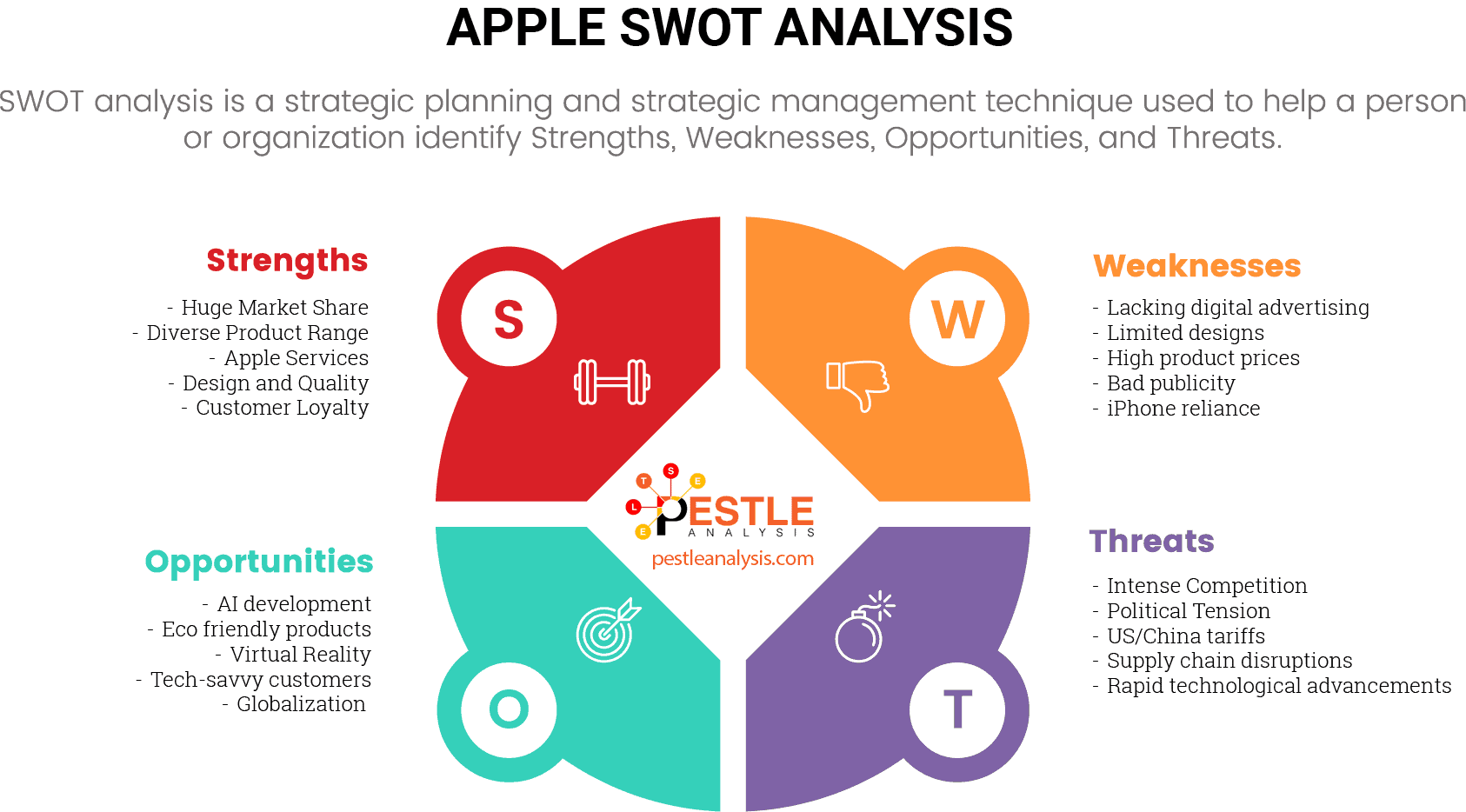
Apple SWOT Matrix (2026)
| Strengths | Weaknesses |
|---|---|
| Strong brand and brand loyalty | iPhone is 53% of net sales |
| Apple ecosystem of 2.5 billion+ active devices | Expensive products limit reach |
| Services: $123.3 billion, 76.2% gross margin | Late start in generative AI; Gemini partnership |
| $132.2 billion net income; $45.8 billion R&D | Minority market share in smartphones and PCs |
| Custom silicon and design quality | Dependence on always-on cloud services |
| Opportunities | Threats |
| On-device AI | EU DMA and US antitrust cases |
| India as market and production base | Intense competition from Samsung, Google, Huawei, Xiaomi |
| Health and wearables | Tariffs and trade disputes |
| Spatial computing (AR and VR) | Memory costs, supply concentration, natural disasters |
| New iPhone designs and Services | Patent disputes; shifting consumer preferences |
What People Are Saying on X
Fox News reported on November 17 that Apple was "ruling out a cyberattack" and that an internal update "triggered the disruptions." The post drew more than 340,000 views, a measure of how many people wanted to know whether this was an attack.
MTS put Apple in a wider pattern: "The FAA, Microsoft, Chase, the NSA and Apple all went down within a week, and none of it has been tied to a cyberattack." For my analysis, that's the point: the threat to Apple this week was not an outside attacker but its own change process.
Apple Club, a fan account with about 95,000 followers, noted that even "retail store systems went down" and that some services were still listed as slow hours later. When Apple's own fans lead with the outage, it has reached the brand.
NEW: Apple is ruling out a cyberattack after widespread outages disrupted iCloud, Apple Pay, Apple Music and other major services Tuesday.
— Fox News (@FoxNews) November 17, 2026
The company says an internal update triggered the disruptions, with most services now restored as teams work to bring the remaining systems… pic.twitter.com/bMBcKjDHDg
SITUATION EXPLAINED: The FAA, Microsoft, Chase, the NSA and Apple all went down within a week, and none of it has been tied to a cyberattack.
— MTS (@MTSlive) November 18, 2026
• Hackers abused a flaw in Optimizely to plant code on 178 organizations' sites that swapped crypto wallet addresses, skimmed card… pic.twitter.com/FVyVPQJYyL
Apple Outage: "Internal Update" Blamed, Not a Cyberattack
— Apple Club (@ApplesClubs) November 18, 2026
Apple Accounts, iCloud sign-ins, and even retail store systems went down Tuesday around 11:45 a.m. ET. Apple told Bloomberg an internal update caused it, not a cyberattack, and most services are now restored. A few, like… pic.twitter.com/IEVSvWQPTy
Recommendations Based on Apple's SWOT Analysis
If I were advising Apple's new CEO, I would focus on four things:
- Close the AI gap on Apple's terms. Use the chips and the installed base to ship AI features that work on the device and protect privacy.
- Treat reliability as a feature. After November 17, the Services promise depends on safer updates and faster communication.
- Keep diversifying the supply chain. India helps. Memory and component costs need long-term deals.
- Open up before regulators force it. Small, voluntary changes cost less than court orders and fines.
FAQ
What is the SWOT analysis of Apple?
Apple's SWOT analysis shows strengths in its brand, ecosystem, Services and profits; weaknesses in iPhone reliance, high prices and a late AI start; opportunities in on-device AI, India, health and spatial computing; and threats from regulation, competition, trade policy and supply-chain risk.
What is Apple's biggest weakness?
In my view, its reliance on the iPhone. The iPhone was 53% of net sales in fiscal 2026, and much of Services depends on iPhone owners too.
What are Apple's biggest risks?
Regulation of the App Store and its closed platform in the EU and the US, tariffs and supply-chain concentration in Asia, rising memory costs, and the risk of falling behind in AI.
What problems is Apple currently facing?
In late 2026: a CEO transition (John Ternus took over on September 1, 2026), the AI catch-up, the EU and US antitrust cases, memory and component costs, and the November 17 services outage.
What companies does Apple compete with?
In smartphones, Apple's biggest rivals include Samsung, Google, Huawei and Xiaomi. Macs face Microsoft's Windows platform and PC manufacturers such as Dell, HP and Lenovo. In services, Apple competes with Google, Amazon, Spotify and Netflix.
What are the advantages and disadvantages of the iPhone?
The advantages are long software support, privacy features, build quality and tight integration with other Apple products. The disadvantages are a high price and less freedom to mix in other brands' services and devices.
Apple SWOT Analysis: Final Word
Apple enters its next 50 years from a position of strength: record sales of $478.8 billion, a loyal customer base and an ecosystem no rival has matched. Thus, its main risks are not about demand. They are about control: regulators who want the platform open, a supply chain it doesn't own, and an AI layer it now partly rents from Google.
According to this SWOT analysis, the strengths and opportunities still outweigh the weaknesses and threats. If you want to build your own version, here is how to do a SWOT analysis, or summarize it in a SWOT matrix like the one above.
Educational analysis, not investment advice.
Sources
- Apple Inc., Form 10-K for the fiscal year ended Sept. 26, 2026 (filed Nov. 3, 2026)
- Apple Inc., "Apple reports fourth quarter results" (Form 8-K, Exhibit 99.1, Nov. 2, 2026)
- Apple Inc., "Apple reports first quarter results" (Form 8-K, Exhibit 99.1, Jan. 29, 2026; 2.5 billion active devices)
- Apple Inc., Form 8-K (Item 5.02, filed Apr. 20, 2026; CEO transition)
- Computer History Museum: Apple@50 timeline
- Los Angeles Times: Apple turns 50: How a garage startup became a $3.5-trillion titan (Mar. 30, 2026)
- Apple Newsroom: Apple debuts iPhone 16e (Feb. 19, 2025; C1 modem)
- Google: Joint statement from Google and Apple (Jan. 12, 2026)
- CNBC: Apple picks Google's Gemini to run AI-powered Siri coming this year (Jan. 12, 2026)
- Bloomberg: Apple now makes about 25% of iPhones in India after China pivot (Mar. 10, 2026)
- U.S. FDA: FDA authorizes first over-the-counter hearing aid software (Sept. 12, 2024)
- European Commission: Commission finds Apple and Meta in breach of the Digital Markets Act (Apr. 23, 2025)
- U.S. District Court for the District of New Jersey, United States v. Apple Inc., order denying motion to dismiss (June 30, 2025)
- Masimo: statement on the California jury verdict awarding $634 million (Nov. 2025)
- Reuters via Investing.com: Apple works to restore services after outage caused by internal update (Nov. 17, 2026)
- CBS News: Apple restores services after internal update caused outages (Nov. 17, 2026)
- TechCrunch: Apple services, including iCloud, App Store, Apple Music, and more, hit by outage (Nov. 17, 2026)
- MacRumors: Apple blames internal update for outage, says it wasn't a cyberattack (Nov. 17, 2026)
- Fox News: live coverage of the November 17 tech outages (Nov. 17, 2026)
- Fox News on X (Nov. 17, 2026)
- MTS on X (Nov. 18, 2026)
- Apple Club on X (Nov. 18, 2026)


