

This PESTLE analysis of the food industry looks at the Political, Economic, Social, Technological, Legal and Environmental forces shaping what gets grown, cooked, packed and sold in 2026.
I wrote the first version of this page in 2024. Reading it again, I didn't like it. Lots of headings, very few facts.
So I rebuilt it. Every factor now carries a current, dated example with a source at the end of the page. I also kept my promise from the title: there is a worked example for a fast-food chain (McDonald's), plus a short guide on applying this to a restaurant or a small food brand.
It's written for students who need a solid starting point, for restaurant owners, and for anyone at a food company who has to explain "the outside world" to their boss.
New to the framework? PESTLE analysis is a strategic tool that scans six groups of external factors (Political, Economic, Social, Technological, Legal, Environmental) that a business can't control but has to plan around.
Food Industry PESTLE Analysis at a Glance (2026)
If you only have two minutes, this table is the whole analysis in one place.
| Factor | Key drivers in 2026 | Opportunity or threat | Example |
|---|---|---|---|
| Political | Tariffs reset after the US Supreme Court IEEPA ruling; new Section 301 duties; UK junk-food ad limits | Mostly threat (cost and uncertainty) | US Section 301 duties of 10–12.5% on 60 economies from July 24, 2026 |
| Economic | Food inflation cooled, energy and diesel spiked, eating out costs more than groceries | Threat for restaurants, mixed for grocers | US food away from home +3.5% vs food at home +1.8% (Sept 2026) |
| Social | GLP-1 weight-loss drugs, value-seeking shoppers, health and convenience | Threat for snacks and fast food, opportunity for protein and "better for you" | GLP-1 households cut fast-food spending by 8.0% |
| Technological | AI drive-thru ordering, loyalty apps, traceability systems | Opportunity (if the investment pays back) | McDonald's plans AI drive-thru ordering in most US restaurants by end of 2027 |
| Legal | Food traceability, packaging and PFAS rules, ad restrictions, deforestation checks | Threat (compliance cost), opportunity for early movers | EU packaging regulation (PPWR) has applied since August 12, 2026 |
| Environmental | El Niño, extreme weather, food waste, packaging | Threat | FAO Sugar Price Index up 28.8% year on year in October 2026 |
Now the long version.
Food Industry Political Factors
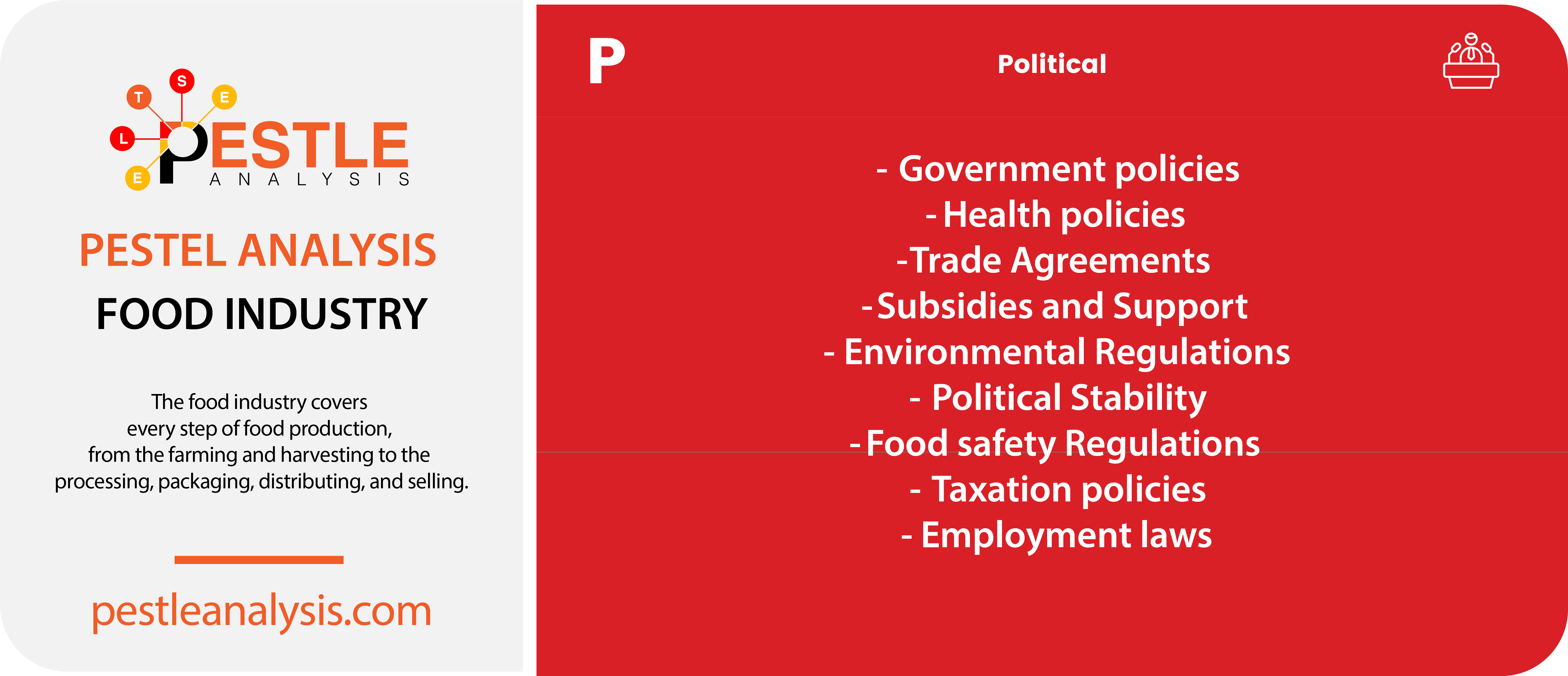
Politics touches food more directly than almost any other industry. Governments decide what crosses borders, what it costs at the border, what can be advertised and to whom. In 2026, all three moved at once.
Trade policy and tariffs on food imports
The big one. On February 20, 2026, the US Supreme Court ruled that tariffs imposed under the International Emergency Economic Powers Act (IEEPA) were unauthorized. Importers started treating those duties as refundable.
That didn't mean the end of tariffs. On July 23, 2026, the US Trade Representative imposed Section 301 duties on 60 economies over forced-labor import rules: 10% for some (including Indonesia, India, Mexico, Canada and the UK) and 12.5% for most others. The same notice carved out products "that cannot be grown or produced in sufficient quantities" in the US, which matters a lot for coffee, cocoa and tropical fruit.
For a food business, the lesson is simple. The rate you paid last year is not a forecast. Supply contracts need tariff clauses, and sourcing needs a plan B.
Sugar, HFSS rules and advertising restrictions
The UK went first. Since January 5, 2026, ads for "less healthy" food and drink (high in fat, salt or sugar) can't run on TV or on-demand services between 5:30am and 9pm, and paid online ads for those products are banned at any time. That includes search ads and paid influencer posts. The government's own estimate is that the rules will remove up to 7.2 billion calories a year from children's diets.
If you sell burgers, crisps or sugary drinks in the UK, your media plan had to change this year. Brand ads that don't show a specific product are still allowed, which is why you'll see a lot more logo-only campaigns.
Farm policy and subsidies
Subsidies shape what is cheap. Biofuel mandates are a good current example: the US EPA set record biomass-based diesel volumes for 2026 and 2027 under the Renewable Fuel Standard, which supports soybean oil demand (and its price). A restaurant buying frying oil feels that, even if it has never heard of the RFS.
Food security and geopolitics
Food security is a political factor again. FAO counts 41 countries that still need external food assistance, 31 of them in Africa, with conflict as the main driver. Wheat and sunflower oil from the Black Sea region keep moving in and out of the headlines as exports are disrupted.
More reading: my guide to political factors.
Food Industry Economic Factors
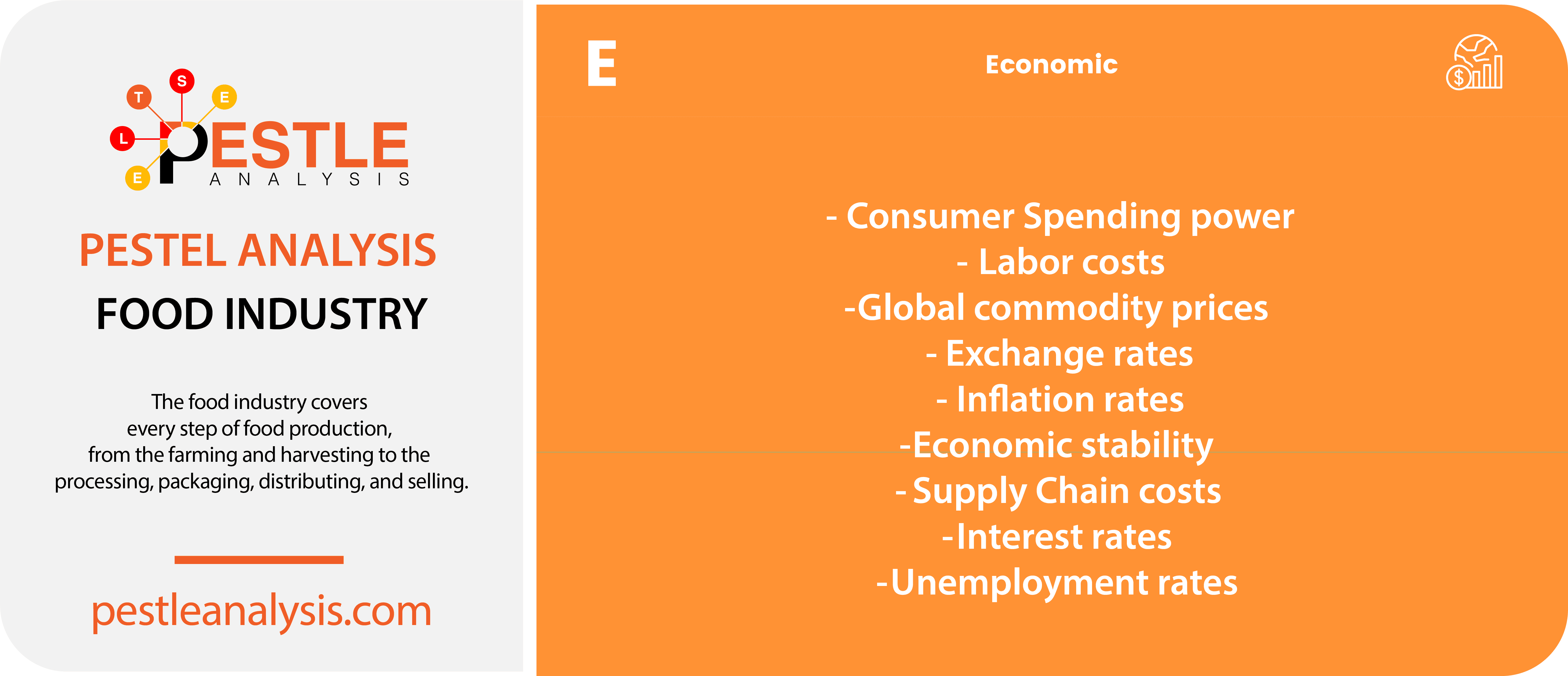
Here's the strange thing about 2026. Grocery inflation is low. Energy inflation is not.
Food inflation and consumers trading down
The latest numbers I could verify:
- US: in the 12 months to September 2026, food at home rose 1.8% and food away from home rose 3.5% (BLS data, as summarized by Purdue's Center for Commercial Agriculture). BLS could not publish 12-month changes for October 2026, because it didn't collect October 2025 data during the government shutdown.
- UK: food and non-alcoholic drink inflation was 1.3% in September 2026, the lowest since September 2021 (ONS). Restaurants and hotels: 3.8%.
- Euro area: food, alcohol and tobacco inflation was 1.6% in October 2026 (Eurostat flash estimate). Unprocessed food was higher, at 4.6%.
See the gap? Cooking at home is getting relatively cheaper than eating out. That is exactly the setup in which households trade down, and restaurant chains respond with value menus.
Labor costs and minimum wages
Restaurants are labor businesses. California's fast-food minimum wage has been $20 an hour since April 2024 (AB 1228). The UK National Living Wage rose to £12.71 an hour on April 1, 2026.
Purdue's analysis puts it neatly: only about 5.4 cents of each food-away-from-home dollar goes to the farm, against roughly 24 cents for food at home. The rest is labor, rent and transport. That's why menu prices keep rising when ingredient prices don't.
Commodity and energy prices
Energy is the headline. ONS dates the start of the conflict in the Middle East to February 28, 2026. Since then, shipping through the Strait of Hormuz has run at reduced levels, and Purdue links the diesel and freight shortages to the disruption there. Brent crude averaged $114 a barrel in September 2026, and US retail diesel passed $6 a gallon for the first time. In the euro area, energy inflation hit 20.8% in October.
Fertilizer comes next. In early October, anhydrous ammonia was about 20% more expensive than a year earlier. Since the Persian Gulf normally supplies about 40% of globally traded urea, a long disruption feeds into 2027 crop costs.
Commodity prices are mixed. The FAO Food Price Index averaged 133.9 points in October 2026: 5.9% higher than a year earlier, but still 16.4% below the March 2022 peak. Sugar is the outlier, up 28.8% year on year.
Delivery and platform economics
Delivery is now part of the cost base, not a bonus channel. The trouble is that delivered food has the most transport in it, so diesel costs hit it first. When I look at a food business in 2026, I want to see delivery margins after commissions and packaging, not just delivery sales.
More reading: economic factors affecting business.
Food Industry Social Factors
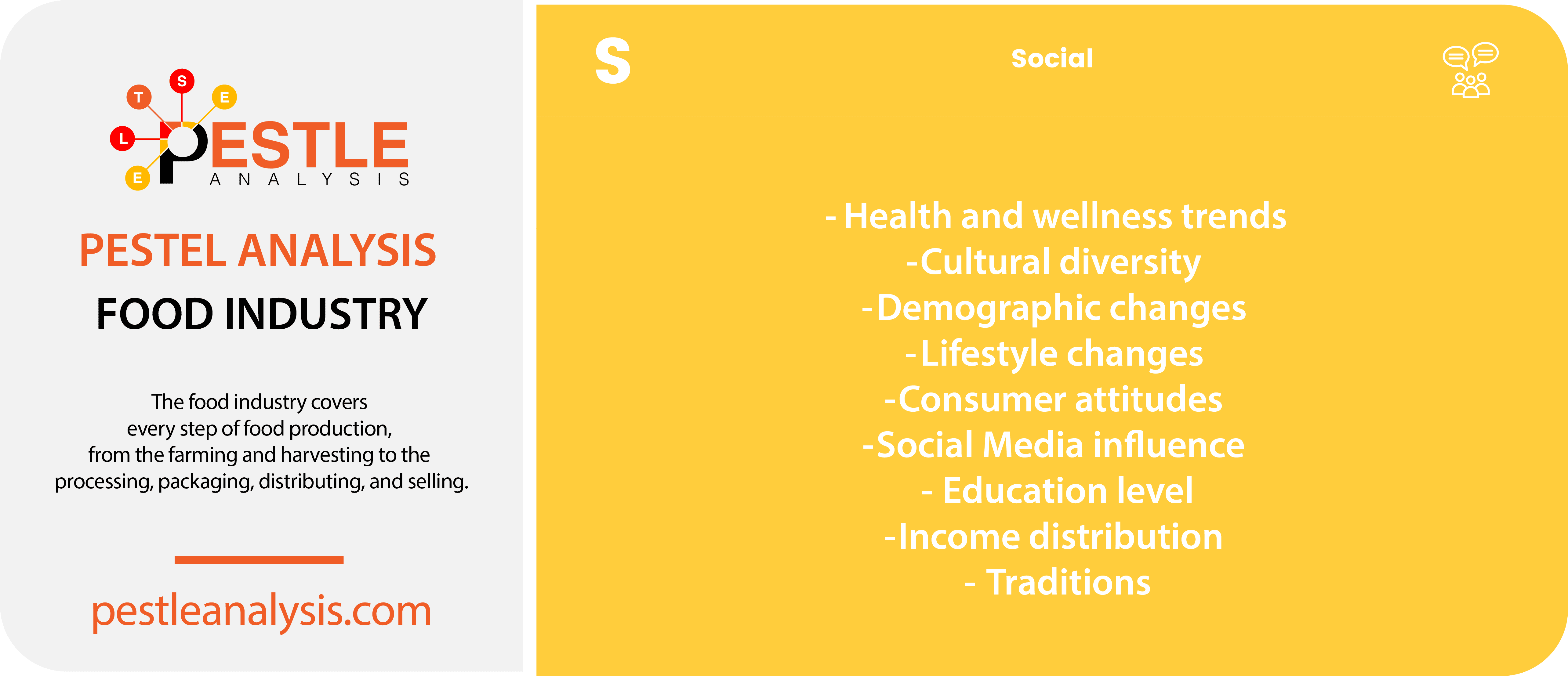
In 2024 I wrote that "healthiness is the focus." True, but vague. In 2026, there is a specific, measurable version of that trend, and it comes in an injection pen.
GLP-1 weight-loss drugs and food demand
The best study I found is from Cornell researchers, published in the Journal of Marketing Research in 2026. They matched survey answers with real purchase data from a representative US household panel. Their findings:
- About 16.3% of US households had at least one GLP-1 user as of July 2024.
- Households cut grocery spending by 5.3% in the six months after starting the drug (8.2% for higher-income households).
- Spending on savory snacks fell 10.1%.
- Spending at fast-food chains, coffee shops and other limited-service restaurants fell 8.0%.
- Yogurt was the biggest winner.
Mind you, households that stopped the medication drifted back toward their old spending. Still, for snack makers and fast-food chains, this is a real threat to volume. For anyone selling protein, portion control or "better for you," it is an opening.
Value-seeking consumers
Lower-income households are squeezed by fuel and basic costs. McDonald's said exactly this in August 2026, when it missed US sales expectations and blamed weak execution of its value deals. Value is no longer a promotion; it's a permanent strategy.
Plant-based and flexitarian diets
Plant-based eating hasn't disappeared, but the hype has cooled. I'd frame it as "flexitarian": people who eat less meat rather than none. For menus, that means one or two strong plant options rather than a whole separate range.
Convenience, delivery and eating habits
Busy schedules still drive convenience food, ready meals and delivery. Combine that with the GLP-1 trend and you get a customer who wants smaller portions, fast, at a fair price. Not an easy brief.
Halal, kosher and cultural diets
Religious and cultural diets are mainstream business, not a niche. Certification (halal, kosher) opens doors to big customer groups and export markets, and getting it wrong is costly for a brand's reputation.
Social media food trends
A single viral video can empty shelves for a product and then forget it a month later. Brands now plan limited-time items around social media cycles. That's an opportunity, as long as the supply chain can keep up.
More reading: social factors affecting business.
Food Industry Technological Factors
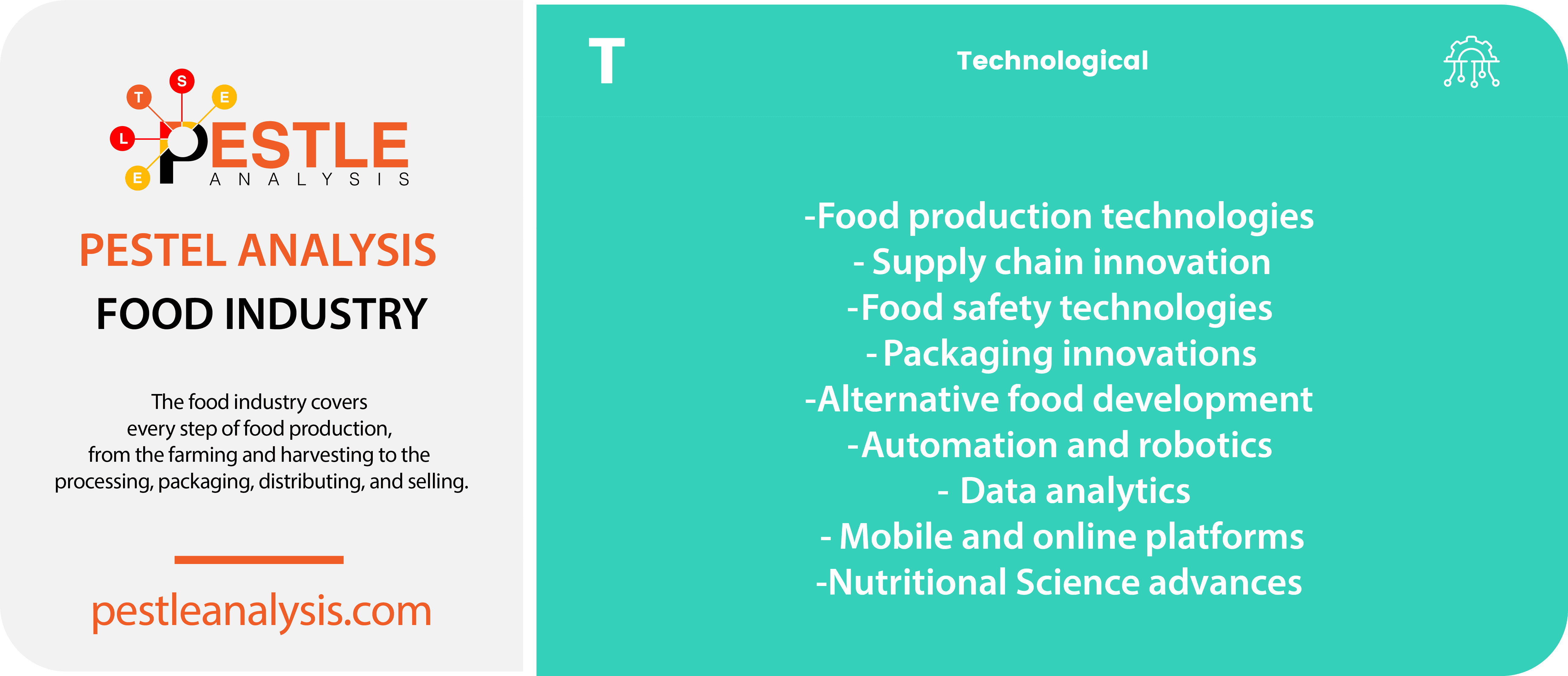
Technology in food is mostly about two things: doing more with fewer labor hours, and knowing exactly where every ingredient came from.
Automation and AI in kitchens and drive-thrus
The most visible example: McDonald's is testing "Archy," an AI ordering voice for drive-thrus in English and Spanish, and expects it in most of its US restaurants by the end of 2027. The company says it could free up at least 50 labor hours a week per restaurant. Some franchisees are skeptical, both about the savings and about whether customers want to talk to a machine.
I share some of that skepticism. Automation pays when it removes boring work. It backfires when it removes hospitality.
Food-safety traceability technology
Traceability software, lot codes and digital records are moving from "nice to have" to "the regulator will ask." I cover the US rule in the Legal section below. The technology point is that the systems to comply (scanning, shared data with suppliers) take years to roll out across a supply chain.
Alternative proteins
Lab-grown meat, fermentation and plant proteins are still small, expensive and heavily regulated. I keep them in the analysis because they could change the cost and carbon math of meat. For now, they are a long-term option, not a 2026 revenue line for most businesses.
Ordering apps and loyalty data
Loyalty programs are where the data lives. McDonald's reported $41 billion of systemwide sales to loyalty members over the twelve months to September 2026. For a smaller restaurant, even a simple app or loyalty card is worth it, because it tells you who comes back and what brings them back.
More reading: technological factors affecting business.
Food Industry Legal Factors
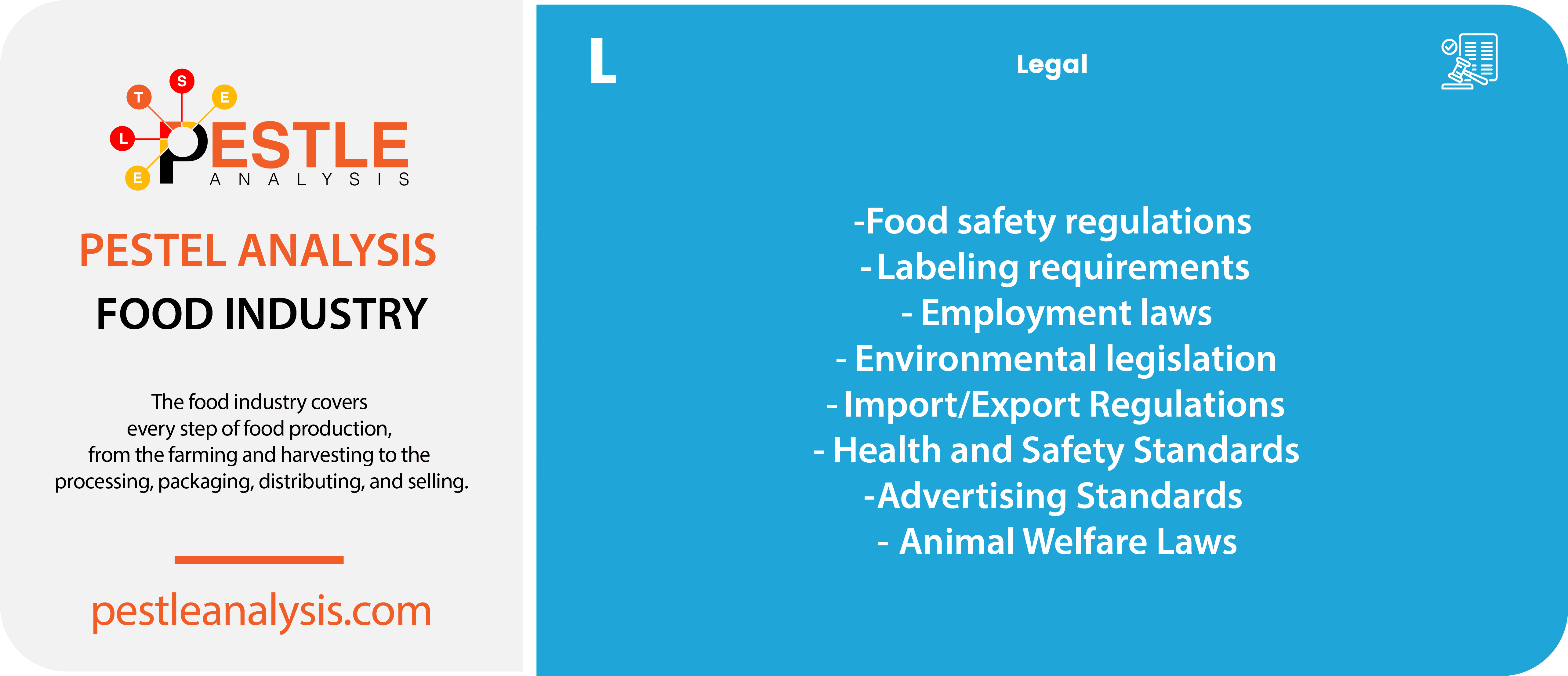
Political factors are about policy direction. Legal factors are about the rules already on paper and what happens if you break them.
Food safety law (US FSMA traceability rule)
The FDA's Food Traceability Rule (FSMA Section 204) requires extra records for foods on the Food Traceability List, and the ability to hand the FDA that information within 24 hours. The original compliance date was January 20, 2026. The FDA proposed moving it to July 20, 2028, and Congress then told the FDA not to enforce the rule before that date. As of November 2026, the extension itself was still a proposal, not a final rule.
So: more time, same requirements. I would not wait until 2028 to start.
Labeling, allergen and packaging chemicals
Labels keep getting stricter. In the EU, the new packaging regulation (more on it below) has restricted PFAS "forever chemicals" in food-contact packaging above set limits since August 12, 2026. In the US, the FDA lists a front-of-package nutrition labeling final rule among its planned regulations.
Advertising to children
The UK restrictions I described under Political factors are now law, enforced day to day by the Advertising Standards Authority with Ofcom as backstop. Small and medium food businesses are exempt from parts of the rules, which is worth knowing if you're a challenger brand.
Employment and franchise law
In the US, the 2023 joint-employer rule (which could have made franchisors more responsible for franchise workers) was vacated by a federal judge in March 2024, and the NLRB formally withdrew it in February 2026. For franchise food chains, that keeps the legal line between brand and franchisee where it was.
Deforestation due diligence
The EU Deforestation Regulation applies to large and medium operators from December 30, 2026 (small and micro operators get until June 30, 2027). If you import cocoa, coffee, palm oil, soy or cattle products into the EU, you need to prove they didn't come from recently deforested land.
More reading: legal factors affecting business.
Food Industry Environmental Factors
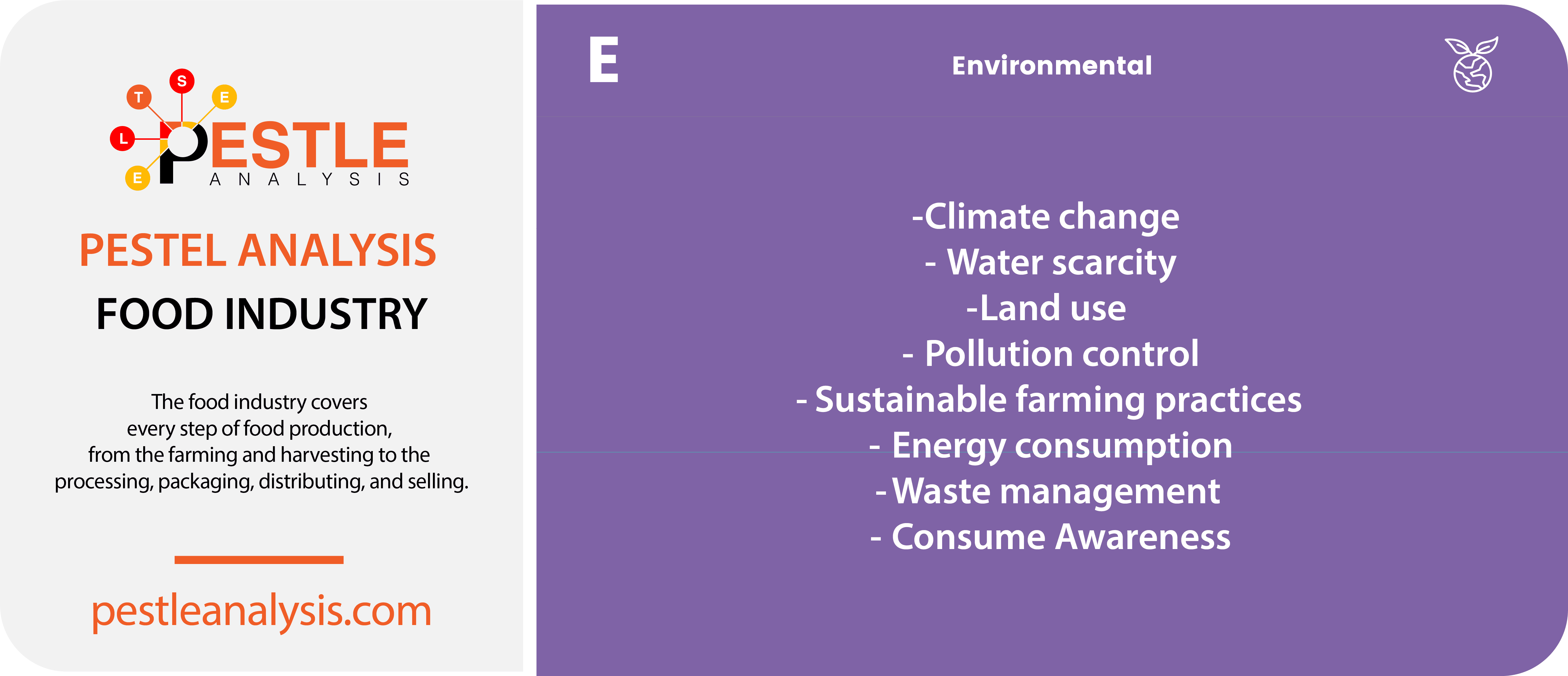
Food is the industry most exposed to weather. It's also one of the biggest sources of waste.
Climate and crops
A strong El Niño is under way. FAO expects its effects on production to stay severe into 2027 in several regions, and rice production is forecast to fall 2.5% in 2026, the first contraction in four seasons. The sugar price spike I mentioned earlier is mostly weather: rain disrupted harvesting in Brazil's main cane region.
Packaging and plastics regulation
The EU Packaging and Packaging Waste Regulation (PPWR, Regulation (EU) 2025/40) has applied since August 12, 2026, in phases. Harmonized recycling labels arrive from 2028. From 2030, all packaging must be recyclable, some single-use formats (small condiment sachets, for example) are restricted, and take-away businesses must let customers bring their own containers at no extra cost.
If you sell take-away food in Europe, start redesigning packaging now. 2030 is closer than it looks in a product cycle.
Food waste
UNEP estimates that 1.05 billion tonnes of food were wasted in 2022 across retail, food service and households. That's 19% of the food available to consumers. Food service alone accounted for about 290 million tonnes. Waste is a cost line before it's an environmental issue, which is why inventory and forecasting tools sell so well.
Water and land use
Meat, dairy and many crops need a lot of water and land. Combined with the deforestation rules above, this pushes companies to know their farms, not just their suppliers.
More reading: environmental factors affecting business.
Worked Example: PESTLE Analysis of a Fast-Food Chain (McDonald's)
The title promises an example, so here it is. McDonald's is the obvious case: global, franchised, and exposed to every factor above. I wrote a full McDonald's PESTLE analysis separately. This is the short version.
| Factor | What it means for McDonald's in 2026 |
|---|---|
| Political | UK ad restrictions limit product ads before 9pm; tariffs and Section 301 duties raise imported input and equipment costs |
| Economic | US comparable sales fell 0.2% in Q3 2026 as lower-income guests cut back; global comparable sales still rose 1.5% |
| Social | GLP-1 users spend about 8% less at fast-food chains; value perception is the battleground |
| Technological | AI drive-thru ordering (Archy) planned for most US restaurants by end of 2027; $41 billion in trailing loyalty sales |
| Legal | Food-safety liability is real: the October 2024 E. coli outbreak linked to onions sickened 104 people in 14 states |
| Environmental | McDonald's says it won't meet its 2030 Scope 3 emissions target, though it remains committed to net zero by 2050 |
Notice how the factors connect. Economic pressure pushes value menus. Value menus squeeze franchisee margins. Technology is supposed to give those margins back. That chain of cause and effect is what a good PESTLE analysis should show, and what a list of headings never will.
Want more fast-food comparisons? See my PESTLE analysis of Subway and my PESTLE analysis of Starbucks. For a packaged-food giant, read my PEST analysis of Nestlé.
How to Use This PESTLE Analysis for a Restaurant or Food Business
Running a single restaurant? Here's how I would adapt this page in an afternoon.
- Shrink the map. Keep the six factors, but ask what each means within 10 kilometers of your door: your local minimum wage, your city's take-away packaging rules, your landlord, your delivery radius.
- Score each factor. For every row in the summary table, mark it as an opportunity or a threat, and give it an impact score from 1 to 5. Be honest. Diesel at a record price is a 5 for a delivery-heavy kitchen.
- Pick three actions. Not ten. For example: renegotiate supplier contracts with fuel clauses, add a smaller-portion menu for GLP-1 customers, and start a loyalty card.
- Review it every six months. Food moves fast. This page needed a rewrite after two years. Yours probably needs one after six months.
If you work in a different corner of the industry, these pages go deeper: the food and beverage industry analysis, the PESTLE analysis of the agriculture industry, the supermarket industry PESTLE analysis and my fast food industry analysis.
Summary
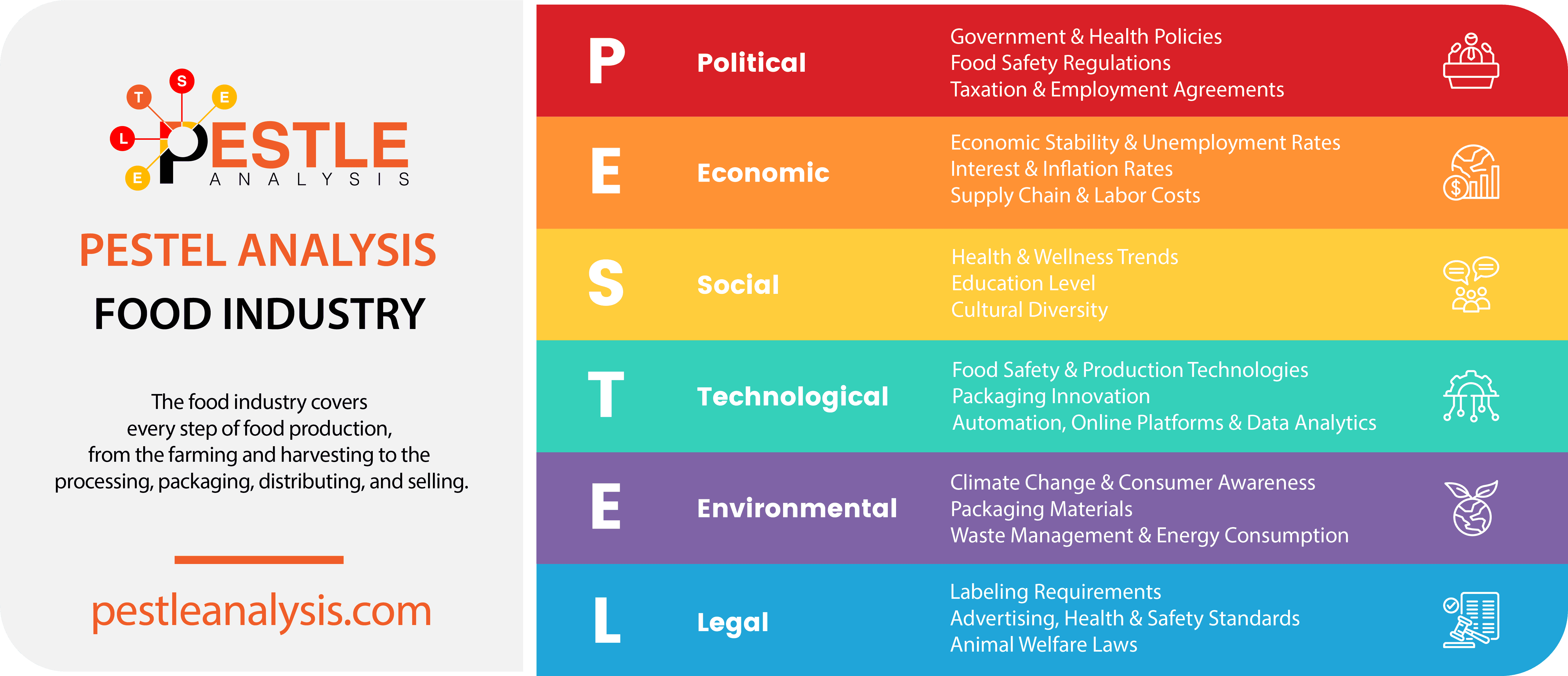
In 2026, the food industry's biggest external threats are energy costs, tariff uncertainty and a customer who is either squeezed or on a weight-loss drug. The biggest opportunities are in value, smaller and healthier portions, and technology that saves labor hours without killing service.
The industry isn't going anywhere. Everyone needs to eat. But the businesses that win will be the ones that read these six factors early, not the ones that react after the invoice arrives.
Next step? Pair this with my SWOT analysis of the food industry to see how internal strengths and weaknesses meet these external forces. You can also browse more PESTLE analysis examples.
I also wrote a PESTLE analysis of Greggs, a major UK bakery and food-on-the-go chain.
I also wrote a PESTLE analysis of Innocent Drinks, the UK smoothie brand owned by Coca-Cola.
FAQ
What is a PESTLE analysis of the food industry?
It's a review of the six groups of external factors (Political, Economic, Social, Technological, Legal and Environmental) that affect food producers, retailers and restaurants. In 2026, the key ones are tariffs, energy costs, GLP-1 drugs, AI ordering, packaging rules and climate.
What political factors affect the food industry?
The main ones are trade policy and tariffs, health policy (sugar taxes and advertising limits such as the UK's ban on less healthy food ads before 9pm), farm and biofuel subsidies, and geopolitical conflict that disrupts supply routes.
What is an example of a PESTLE analysis for a restaurant?
Take a fast-food restaurant: Political = local wage laws and ad rules; Economic = food and energy costs and customers trading down; Social = health trends and GLP-1 users; Technological = ordering apps and kiosks; Legal = food safety and labeling; Environmental = packaging and waste. My worked McDonald's example above shows it in a table.
What are the main external threats to food businesses?
In 2026: high energy and diesel costs, tariff changes, rising labor costs, lower demand from GLP-1 users, stricter packaging and advertising rules, and weather shocks from El Niño.
How does PESTLE help food industry marketing strategy?
It shows marketers what they can and can't say (ad restrictions), what customers are looking for (value, smaller portions, health) and which channels matter (apps, loyalty, delivery). That turns a generic campaign into one that fits the market as it is today.
What is the difference between a PESTLE and a SWOT analysis of the food industry?
PESTLE looks only outward, at forces a company can't control. A SWOT adds the inside view: strengths and weaknesses of a specific company, plus opportunities and threats. PESTLE results usually feed the "Opportunities" and "Threats" boxes of a SWOT analysis.
Sources
- US Bureau of Labor Statistics, "Consumer Price Index – October 2026" (Nov 10, 2026): https://www.bls.gov/news.release/cpi.nr0.htm
- Purdue Center for Commercial Agriculture, "The September 2026 CPI and PPI Reports: Energy Drives Energy, Not Grocery Prices" (Oct 21, 2026): https://ag.purdue.edu/commercialag/home/paer-article/the-september-2026-cpi-and-ppi-reports-energy-drives-energy-not-grocery-prices/
- Office for National Statistics, "Consumer price inflation, UK: September 2026" (Oct 21, 2026): https://www.ons.gov.uk/economy/inflationandpriceindices/bulletins/consumerpriceinflation/september2026
- Eurostat, "Euro area annual inflation up to 4.0%" (flash estimate, October 2026): https://ec.europa.eu/eurostat/web/products-euro-indicators/w/2-04112026-ap
- FAO, "FAO Food Price Index edges down in October amid subdued demand" (Nov 6, 2026): https://www.fao.org/newsroom/detail/fao-food-price-index-edges-down-in-october-amid-subdued-demand/en
- NIKE, Inc., Form 10-K for fiscal 2026 (note on the Feb 20, 2026 Supreme Court IEEPA ruling): https://www.sec.gov/Archives/edgar/data/320187/000032018726000088/nke-20260531.htm
- Office of the US Trade Representative, "USTR Takes Action in Forced Labor Section 301 Investigations" (Jul 23, 2026): https://ustr.gov/about/policy-offices/press-office/press-releases/2026/july/ustr-takes-action-forced-labor-section-301-investigations
- GOV.UK (DHSC), "Landmark junk food ad ban to protect kids' health" (Jan 5, 2026): https://www.gov.uk/government/news/landmark-junk-food-ad-ban-to-protect-kids-health
- ASA / CAP, "Less healthy food and drink advertising: regulatory statement": https://www.asa.org.uk/static/35791f5d-ab93-4742-98de2796f0f86aba/Less-healthy-foods-regulatory-statement.pdf
- Hristakeva et al., "The No-Hunger Games: How GLP-1 Medication Adoption Is Changing Consumer Food Demand," Journal of Marketing Research 63(3), 2026: https://doi.org/10.1177/00222437251412834
- Cornell Chronicle, "Ozempic is changing the foods Americans buy" (Dec 2025): https://news.cornell.edu/stories/2025/12/ozempic-changing-foods-americans-buy
- FDA, "FSMA Final Rule on Requirements for Additional Traceability Records for Certain Foods": https://www.fda.gov/food/food-safety-modernization-act-fsma/fsma-final-rule-requirements-additional-traceability-records-certain-foods
- FDA, "Foods Program Regulations Under Development": https://www.fda.gov/food/guidance-documents-regulatory-information-topic-food-and-dietary-supplements/foods-program-regulations-under-development
- European Commission, "New EU rules on packaging enter into application" (Aug 2026): https://environment.ec.europa.eu/news/new-eu-rules-packaging-enter-application-2026-08-11_en
- European Commission, "Packaging waste" (PPWR overview): https://environment.ec.europa.eu/topics/waste-and-recycling/packaging-waste_en
- European Commission, "EU Deforestation Regulation (EUDR)": https://environment.ec.europa.eu/topics/forests/deforestation/eu-deforestation-regulation-eudr_en
- NLRB, "NLRB's Joint-Employer Rule Vacated by U.S. District Judge" (Mar 2024): https://www.nlrb.gov/news-outreach/news-story/nlrbs-joint-employer-rule-vacated-by-us-district-judge
- Federal Register, "Withdrawal of 2023 Standard for Determining Joint Employer Status" (Feb 27, 2026): https://www.federalregister.gov/documents/2026/02/27/2026-03955/withdrawal-of-2023-standard-for-determining-joint-employer-status
- California Department of Industrial Relations, Fast Food Council (AB 1228): https://www.dir.ca.gov/AB1228/AB1228.html
- GOV.UK, "National Minimum Wage and National Living Wage rates": https://www.gov.uk/national-minimum-wage-rates
- UN News, "With 783 million people going hungry, a fifth of all food goes to waste" (UNEP Food Waste Index Report 2024): https://news.un.org/en/story/2024/03/1148036
- Restaurant Dive, "McDonald's aims for nationwide drive-thru AI in 2027" (Nov 5, 2026): https://www.restaurantdive.com/news/mcdonalds-expands-drive-thru-voice-archy-tests/873788/
- McDonald's, "McDonald's Reports Third Quarter 2026 Results" (Nov 4, 2026): https://mcdonalds.mediaroom.com/2026-11-04-McDONALDS-REPORTS-THIRD-QUARTER-2026-RESULTS
- Reuters via Investing.com, "McDonald's US sales growth slows as value push falters" (Aug 4, 2026): https://www.investing.com/news/stock-market-news/mcdonalds-us-sales-disappoint-as-value-deals-fail-to-draw-enough-diners-4833836
- CDC, "E. coli Outbreak Linked to Onions Served at McDonald's": https://www.cdc.gov/ecoli/outbreaks/e-coli-O157.html
- Ofcom, "Note to Broadcasters: less healthy food and drink restrictions" (brand advertising exemption): https://www.ofcom.org.uk/siteassets/resources/documents/about-ofcom/bulletins/broadcast-bulletins/2025/536/note-to-broadcasters-lhf-restrictions.pdf
- legislation.gov.uk, Communications Act 2003, section 368Z14 (online ban and SME exemption): https://www.legislation.gov.uk/ukpga/2003/21/section/368Z14
- ESG Today, "McDonald's to Miss 2030 Value Chain Decarbonization Goal, Remains Committed to Net Zero by 2050" (May 27, 2026): https://www.esgtoday.com/mcdonalds-to-miss-2030-value-chain-decarbonization-goal-remains-committed-to-net-zero-by-2050/
- JMIC Advisory Update 113 (Nov 12, 2026): https://www.ukmto.org/-/media/ukmto/products/jmic_advisory_update_113_12-nov.pdf


