

Quick answer: Political factors in a PESTLE analysis are the ways government action and political conditions affect a business: policy, trade, taxes, regulation, elections and stability. They are external. A company can’t control them, but it can track them, judge their impact and plan for them before they reach its costs or its markets.
The 7 political factors I check: government policies, trade policies, taxation policies, general political issues, changes in leadership, regulation trends and political trends.
On this page: The 7 factors · At a glance · Political vs legal · How to analyse · Real examples · FAQ
Writing your own PESTLE? Start the P row with my free PESTLE template.
What Are Political Factors in PESTLE Analysis?
Political factors are the P in PESTLE (or PESTEL, same framework, different letter order). They cover what governments decide, how they decide it, and how stable that process is.
I’ll be blunt: most businesses notice a political factor only when it lands on an invoice. A tariff, a tax change, a subsidy that disappears overnight. The point of putting politics first in a PESTLE analysis is to see those changes coming.
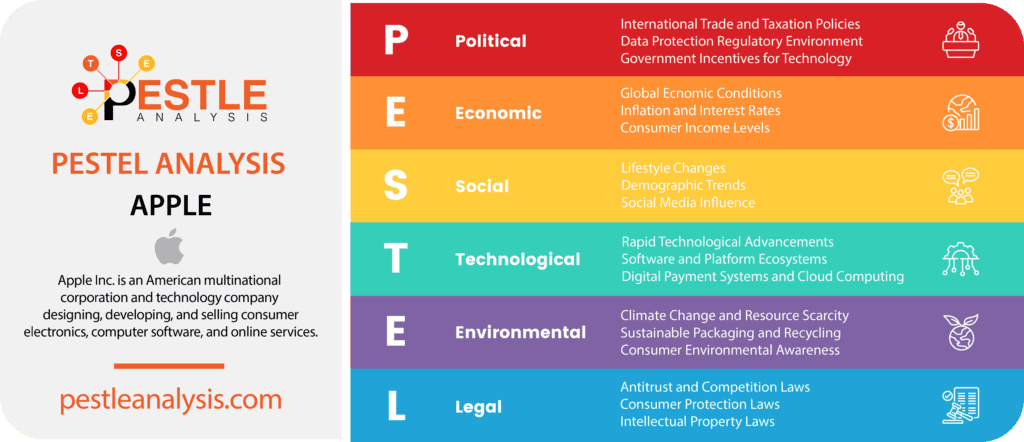
Notice that political factors sit in the first row of my Apple PESTLE analysis above. They also appear in every cousin of PESTLE: PEST, STEP, STEEP, STEEPLE, STEEPLED and DESTEP. For more worked cases, see my PESTLE analysis examples.
Why Political Factors Matter: They Shape the Other Five
Political factors carry the same weight as the other five PESTLE factors. But they have one unique trait, and it’s the reason I always start with them.
They move the other five.
- Economic: a tariff decision changes import prices, and through them inflation and margins.
- Social: a public-health policy, such as the UK’s limits on junk-food advertising, changes what people see and buy.
- Technological: an industrial subsidy decides where factories and research labs get built.
- Legal: today’s policy decision becomes tomorrow’s law (more on that below).
- Environmental: climate policy sets the carbon rules a business has to price in.
That chain is a big part of the advantages of PESTLE analysis. Get the political row wrong, and the errors spread down the grid.
The 7 Political Factors Affecting Business
For each factor, I list the questions I ask myself when I do a PESTLE analysis, then one dated, sourced example and a line on who wins and who loses. Political factors are rarely bad for everyone. They move money from one group of companies to another.
Government Policies
Questions I Ask: - What specific government policy will positively affect the organization? - Which government policies will make the business suffer? - What newly introduced government policy will impact the business’s operations? - How exactly will this policy force the organization to change its course, and perhaps its business plan?
Example: industrial policy for chips (US, 2022 onward). On August 9, 2022, the US CHIPS and Science Act was signed into law. The Department of Commerce oversees about $50 billion under it, including $39 billion for manufacturing incentives and $11 billion for research and development. In December 2024, Commerce announced an award of up to $4.745 billion for Samsung’s planned investment in Central Texas.
Who wins and who loses: chipmakers that build in the US get help with the bill. Rivals that build elsewhere compete against subsidized capacity. Suppliers near the new plants gain customers.
Trade Policies
Questions I Ask: - Did the government impose new tariffs or quotas on imported goods and services? - Are there any trade embargoes? - Is there a free trade agreement in place?
Example: US tariffs, 2025–2026. In 2025, the US imposed sweeping tariffs under the International Emergency Economic Powers Act (IEEPA), including “reciprocal” duties of at least 10% on imports from all trading partners. On February 20, 2026, the US Supreme Court ruled that IEEPA does not authorize the President to impose tariffs. The same day, the White House announced a temporary 10% import duty under Section 122 of the Trade Act of 1974, for 150 days from February 24. Then, on July 23, 2026, the US Trade Representative imposed Section 301 duties of 10% or 12.5% on 60 economies over their failure to ban imports made with forced labor.
Three legal tools in under a year. The direction stayed; the instrument changed.
Who wins and who loses: importers that paid IEEPA duties became refund claimants. Nike, for example, booked a $986 million benefit in its fiscal fourth quarter for the expected recovery of those tariffs. Companies sourcing from the countries hit hardest by the new duties face higher landed costs. I cover the 2025 starting point in my PESTLE breakdown of Trump’s tariffs, the US side in my PESTLE analysis of the USA, and the other side of the US–China relationship in my PESTLE analysis of China.
I went deeper on how tariffs hit one industry in my members-only analysis of EU tariffs on Chinese EVs.
Taxation Policies
Questions I Ask: - Did the government change the corporate income tax? - Any changes in VAT? These can severely affect the organization’s profitability. - Did payroll taxes increase to fund social insurance programs? - Did the government introduce environmental taxes or levies? These also feed into the environmental and legal factors of a PESTLE analysis, because they push organizations to change how they operate.
Example: Ireland’s corporate tax. Ireland has applied a 12.5% corporation tax rate since 2003. For many years, that low rate was a key part of Ireland’s pitch to multinationals. Then the politics changed. Ireland signed up to the OECD two-pillar agreement in October 2021, and from December 31, 2023 it applies a 15% minimum effective rate to in-scope groups, generally those with revenues of €750 million or more. Smaller businesses stay at 12.5%; the Irish government says that covers over 99% of companies operating in Ireland.
Who wins and who loses: small and mid-sized firms in Ireland keep the 12.5% rate. Large multinationals lose part of the gap that made Ireland stand out on tax alone, so other things (talent, EU market access, English language) matter more in their location decisions. If I’m doing a PESTLE analysis on a big tech company with a European base in Ireland, this goes in the political row.
General Political Issues
Questions I Ask: - What do labor and employment look like in the country the organization operates in? - Is there any specific policy standing out for civil rights or liberties? - Is there any concern regarding national security? - Any key developments in healthcare and education policies?
Here I include any policy that doesn’t fall under the rest of the list.
Example (historical): the Affordable Care Act. The Affordable Care Act (ACA), passed in 2010 and also known as “Obamacare”, aimed to improve the quality and affordability of health care in the US. It required larger employers to act. Under its employer shared responsibility provisions, an employer with an average of at least 50 full-time employees (including full-time equivalents) must offer qualifying health coverage to full-time staff, or it may owe a payment to the IRS.
If I had been doing a PESTLE analysis of a US organization in 2010, the ACA would have been a political factor. Today, the rules are in force, so for a current analysis the employer mandate belongs mostly in the legal row. That shift is exactly the political-to-legal journey I explain further down.
Who wins and who loses: employers already offering health insurance had little to change. Employers near the 50-employee line had a new cost to plan around.
Changes in Leadership
Questions I Ask: - Who are the current political leaders? - Have there been any recent elections, or are any coming? - How stable is the current political system? - The organization I’m analyzing operates in a specific industry. Does the leadership support or challenge that industry?
Example: Argentina under Javier Milei (2023–2025). Milei took office on December 10, 2023. Two days later, Economy Minister Luis Caputo announced that the official peso rate would move to about 800 per US dollar, from roughly 366, alongside cuts to energy and transport subsidies. In April 2025, Argentina agreed a $20 billion, 48-month program with the IMF, and its central bank lifted key currency controls and let the peso float within a band of 1,000 to 1,400 per dollar. It also allowed companies to pay dividends to foreign shareholders for fiscal years starting in 2025.
Who wins and who loses: exporters and foreign investors waiting to send profits home gained from the new rules. Importers and anyone with peso costs and dollar debts took the hit from the devaluation. If I’m analyzing an organization operating in Argentina, or one exposed to it, a change of this size goes straight into the political row.
Regulation Trends
Questions I Ask: - What regulation trends are emerging in industries worldwide? - How are governments adapting to new shifts in society? - What kind of regulation has been introduced following a technological shift?
Example: AI regulation, two directions (2024–2026). The EU chose to regulate AI with one horizontal law. The AI Act entered into force on August 1, 2024 and became applicable on August 2, 2026, with exceptions. Prohibited practices applied from February 2, 2025, and rules for general-purpose AI models from August 2, 2025. After a political agreement to simplify the law, some high-risk rules were pushed back to December 2, 2027 and August 2, 2028.
The US went the other way at federal level. On January 20, 2025, the new administration revoked Executive Order 14110 on AI safety, and three days later it ordered a review of actions taken under it, under the title “Removing Barriers to American Leadership in Artificial Intelligence.”
Who wins and who loses: large firms with compliance teams can absorb EU rules more easily than start-ups. A company selling AI products on both sides of the Atlantic now runs two playbooks. If an organization relies heavily on AI, I put this trend in its political row, and the specific obligations in its legal row.
Political Trends
Questions I Ask: - How is the political environment changing? - Do people’s views tend to shift lately? - How will this affect the business I am doing a PESTLE analysis of?
Example: when a shift in public opinion reaches the ballot. The rise of populist and nationalist politics in several countries matters for business because it tends to question globalization and free trade. You see it most clearly when it reaches a vote. In the UK’s referendum on EU membership on June 23, 2016, 51.9% voted to leave. That single result reshaped trade, labor and regulation for every company doing business between the UK and the EU.
A broader trend runs across party lines: governments want more production at home. The CHIPS Act used subsidies; the 2025–26 US tariffs used duties, and the White House described their aim as “reshoring domestic production.” Different tools, same direction.
Who wins and who loses: domestic producers in protected or subsidized sectors gain. Companies built on long, cheap global supply chains face higher costs and more paperwork. If I’m analyzing a global organization, I put the trend in its political row and watch the next election calendar closely.
Political Factors at a Glance
| Factor | Questions I ask | Example (year) | Typical impact on business |
|---|---|---|---|
| Government policies | Which policies help or hurt the business? What new policy is coming? | US CHIPS and Science Act (2022) | Subsidies change where companies invest |
| Trade policies | New tariffs, quotas or embargoes? Any free trade agreement? | US IEEPA tariffs struck down; Section 122, then Section 301 duties (2025–26) | Import costs, sourcing choices, refund claims |
| Taxation policies | Corporate tax, VAT or payroll tax changes? | Ireland’s 15% minimum rate for large groups (from Dec 31, 2023) | After-tax profit, choice of location |
| General political issues | Labor, civil rights, security, health and education policy? | US Affordable Care Act employer rules (passed 2010) | Labor costs, HR obligations |
| Changes in leadership | Who leads? Elections coming? Does leadership back the industry? | Argentina: devaluation (Dec 2023), currency controls eased (Apr 2025) | Exchange rates, profit repatriation, demand |
| Regulation trends | What new rules follow a technology or social shift? | EU AI Act vs US revocation of EO 14110 (2024–26) | Compliance cost, product design, market access |
| Political trends | How are voters’ views shifting? | UK EU referendum (2016); reshoring push (2022–26) | Trade access, supply-chain design |
More Political Factors to Watch
The 7 factors above are my core list. These are the extras I check when the business is exposed to them, one line each:
- Elections: a vote can change any of the 7 factors at once. Mark the dates.
- Political stability: coups, contested results or a collapsing coalition raise every other risk.
- Sanctions: they can close a market or a supplier overnight.
- Subsidies and grants: they can make a rival cheaper than you, or make you cheaper than them.
- Government spending: public contracts are a market of their own in defense, health and infrastructure.
- Corruption: it adds hidden costs and legal exposure.
- Bureaucracy and red tape: permits and licenses decide how fast you can open or expand.
- War and conflict: they disrupt supply routes, energy prices and staff safety.
- Immigration policy: it shapes who you can hire and how fast.
- Non-tariff barriers: standards, quotas and customs checks can block trade without a single tariff.
- Intellectual property policy: how well a country protects patents and trademarks decides what you’ll risk launching there.
- Protests and strikes: they can stop ports, factories and public services.
Political vs Legal Factors: What's the Difference?
This is the question I get most often about PESTLE, and the line is simpler than it looks.
Political factors are what governments decide and how stable they are. Intentions, policies, elections, negotiations. Legal factors are the laws in force that a business must comply with, plus the courts and regulators that enforce them.
A useful test: if it’s still a decision, a promise or a negotiation, it’s political. If it’s written into law and you can be fined for ignoring it, it’s legal.
| Political decision | Resulting law or ruling (legal factor) |
|---|---|
| The EU decides to regulate AI with one law | The AI Act, in force since Aug 1, 2024, applicable from Aug 2, 2026 |
| EU leaders decide personal data needs stronger protection | The GDPR, which has applied since May 25, 2018 |
| The US chooses tariffs as a trade weapon (2025) | The Supreme Court IEEPA ruling (Feb 20, 2026) and the refund claims after it |
| The UK decides to tackle childhood obesity | Limits on junk-food ads on TV and online, in force since Jan 5, 2026 |
| Congress decides to expand health coverage | The ACA employer shared responsibility rules |
Notice the GDPR in that table. In the earlier version of this page, I listed it under Government Policies. Strictly speaking, it’s a legal factor: a regulation businesses must comply with. The political factor was the decision to make one.
In practice, a factor can start in the political row and move to the legal row as it becomes law. Put it where it helps your argument, and don’t count it twice. For the legal side in depth, read my guide to legal factors.
How to Analyse Political Factors (Political Risk)
Political risk is the chance that a political decision or event hurts your business. This is how I analyze it, step by step.
- List the countries and levels of government that matter. Where do you sell, source, employ and pay tax? Include local and regional governments, not only national ones.
- Collect the data. Start with primary sources, and date every fact (see the table below).
- Score impact and likelihood. I use 1 to 5 for each and multiply them. A 5 × 5 goes to the top. A 1 × 2 can wait.
- Write one scenario for the biggest risk. What happens to revenue, costs and supply if it happens next quarter? What would you do on day one?
- Feed the results into a SWOT. The top political factors become Opportunities or Threats. Here is how I feed it into a SWOT.
| Where I look | What it gives me |
|---|---|
| Government, parliament and trade-ministry sites, official gazettes | Policies, laws and tariff notices, at the source |
| Central banks | Currency and capital-control decisions |
| The OECD and the IMF | Tax agreements, country programs, policy reviews |
| World Bank Worldwide Governance Indicators | Long-run measures of political stability, rule of law and corruption control |
| PRS Group Political Risk Yearbook (often via university libraries) | Country risk reports with forecasts |
| Company annual reports (risk-factors section) | How companies themselves rank their political exposure |
I score each political factor for impact and likelihood. Start with my free PESTLE template, add a score column next to each factor, and you can do the same. For the full method across all six letters, see how I do a full PESTLE analysis.
Examples of Political Factors in Real PESTLE Analyses
Definitions are easy. Here’s how political factors look in the analyses I keep on this site.
Nike. In my PESTLE analysis of Nike, updated in November 2026, US trade policy is the single biggest political factor. In fiscal 2026, factories in Vietnam, Indonesia and China made about 52%, 27% and 16% of Nike Brand footwear, so every tariff change hits the cost of a shoe. US–China relations matter on the sales side too. Back in June 2021, after a consumer boycott in China linked to Nike’s statement on Xinjiang cotton, then-CEO John Donahoe told analysts: “Nike is a brand that is of China and for China.” (The 2024 version of this page said that was during the US–China trade war. It was in June 2021, on Nike’s fourth-quarter earnings call.)
The food industry. In my PESTLE analysis of the food industry, I wrote: “Politics touches food more directly than almost any other industry. Governments decide what crosses borders, what it costs at the border, what can be advertised and to whom.” In 2026, tariffs, advertising limits and farm subsidies all moved at once.
Tesla. When I wrote my PESTEL analysis of Tesla in 2024, I listed the extension of US EV tax credits as a tailwind. The Inflation Reduction Act of 2022 had extended the new clean vehicle credit through 2032. That political factor has since reversed. The law known as the One Big Beautiful Bill, signed on July 4, 2025, ended the credit for vehicles acquired after September 30, 2025. A tailwind became a headwind in one budget cycle.
A few more company pages where the political row does a lot of work: - Starbucks’ political factors: coffee sourcing and global trade policy across many countries. - Apple’s political factors: US–China trade tension and dependence on manufacturing in China. - Amazon’s political factors: antitrust scrutiny, including the EU investigation opened in 2019. - Tesco’s political factors: trade agreements, Brexit and government stability.
What People Are Saying on X
Trade is where politics and law now run side by side, and it’s one of the most discussed political factors on X. Peter Harrell, a senior fellow at the Council on Foreign Relations, walked through the open court cases against the Section 301, Section 338 and Section 122 tariffs, and the IEEPA refund litigation. As he put it, the government “has refunded (or is about to refund) about 80% of the total IEEPA duties,” with “some $20 billion or so” still outstanding. That’s the political vs legal distinction above, playing out in real time: the tariffs were a political decision, and the courts decided what happens to the money.
Flagging a number of updates across the various lawsuits against Trump's tariffs:
— Peter Harrell (@petereharrell) November 5, 2026
1. Section 301 litigation: Last night the Court of International Trade (CIT) issued an order in the challenge against Trump's July 24 Section 301 tariffs--which impose 10% or 12.5% tariffs on most…
FAQ
What are political factors in a PESTLE analysis?
They are the ways government action and political conditions affect a business: government policies, trade policies, taxes, general political issues, changes in leadership, regulation trends and political trends. They are the P in PESTLE and PESTEL.
What is an example of a political factor?
A tariff is the classic one. In 2026, the US Supreme Court ruled that tariffs imposed under IEEPA were unauthorized, and the government replaced them with a temporary Section 122 duty and then Section 301 duties of 10% or 12.5% on 60 economies. Each change altered import costs for thousands of companies.
What are the five (or seven) political factors?
Lists vary by textbook. I use seven: government policies, trade policies, taxation policies, general political issues, changes in leadership, regulation trends and political trends. Five-factor lists usually merge some of these, for example taxation into government policy.
What is the difference between political and legal factors?
Political factors are what governments decide and how stable they are. Legal factors are the laws in force that a business must comply with. A plan to regulate AI is political; the EU AI Act, once in force, is legal.
How do political factors affect a business?
They change costs (tariffs, taxes), demand (subsidies, public spending), access to markets (sanctions, trade deals), and the rules a business must follow. They also move the other five PESTLE factors, which is why I analyze them first.
Are political factors always threats?
No. The same decision can be a threat for one company and an opportunity for another. A tariff hurts importers but can help domestic producers. A subsidy helps the companies that receive it and squeezes the ones that don’t.
What are the 7 external factors?
There’s no single standard list. Sources that count seven usually take the six PESTLE factors and add one more, and the extra one varies. My own guide to external factors affecting business covers eight types, with political factors first.
Which political factor is hardest to track in your industry? Let me know in the comments below.
More External Factors Affecting Business
Political factors are the first part of every PESTLE analysis. Here are the other five:
Sources
- U.S. Department of Commerce, “Commerce Celebrates First Anniversary of CHIPS and Science Act” (Aug. 9, 2023): https://www.commerce.gov/news/blog/2023/08/commerce-celebrates-first-anniversary-chips-and-science-act
- U.S. Department of Commerce, “Biden-Harris Administration Announces CHIPS Incentives Award with Samsung Electronics…” (Dec. 20, 2024): https://www.commerce.gov/news/press-releases/2024/12/biden-harris-administration-announces-chips-incentives-award-samsung
- Supreme Court of the United States, Learning Resources, Inc. v. Trump, No. 24-1287 (decided Feb. 20, 2026), slip opinion: https://www.supremecourt.gov/opinions/25pdf/24-1287_4gcj.pdf
- The White House, “Fact Sheet: President Donald J. Trump Imposes a Temporary Import Duty to Address Fundamental International Payment Problems” (Feb. 20, 2026): https://www.whitehouse.gov/fact-sheets/2026/02/fact-sheet-president-donald-j-trump-imposes-a-temporary-import-duty-to-address-fundamental-international-payment-problems/
- Office of the US Trade Representative, “USTR Takes Action in Forced Labor Section 301 Investigations” (July 23, 2026): https://ustr.gov/about/policy-offices/press-office/press-releases/2026/july/ustr-takes-action-forced-labor-section-301-investigations
- NIKE, Inc., Form 10-K for the fiscal year ended May 31, 2026 (IEEPA tariff recovery; sourcing shares): https://www.sec.gov/Archives/edgar/data/320187/000032018726000088/nke-20260531.htm
- Government of Ireland, Department of Finance, “Minister McGrath notes Ireland’s application of effective 15% corporation tax rate for in-scope businesses” (Dec. 31, 2023): https://www.gov.ie/en/department-of-finance/press-releases/minister-mcgrath-notes-irelands-application-of-effective-15-corporation-tax-rate-for-in-scope-businesses/
- Revenue (Irish Tax and Customs), “What are the Pillar Two rules?”: https://www.revenue.ie/en/companies-and-charities/pillar-two/what-is/pillar-two-rules.aspx
- Internal Revenue Service, “Employer shared responsibility provisions”: https://www.irs.gov/affordable-care-act/employers/employer-shared-responsibility-provisions
- Reuters, “Argentina devalues peso, cuts spending to treat fiscal deficit ‘addiction’” (Dec. 13, 2023): https://www.reuters.com/markets/argentina-braces-economic-shock-package-peso-shackled-2023-12-12/
- Banco Central de la República Argentina, “Beginning of stage 3 of the economic program…” (Apr. 11, 2025): https://www.bcra.gob.ar/en/news/inicio-de-la-fase-3-del-programa-economico/
- International Monetary Fund, “IMF Executive Board Approves 48-month US$20 billion Extended Arrangement for Argentina” (Apr. 12, 2025): https://www.imf.org/en/news/articles/2025/04/12/pr25101-argentina-imf-executive-board-approves-48-month-usd20-billion-extended-arrangement
- European Commission, “AI Act” (regulatory framework and application timeline): https://digital-strategy.ec.europa.eu/en/policies/regulatory-framework-ai
- Federal Register, Executive Order 14148, “Initial Rescissions of Harmful Executive Orders and Actions” (signed Jan. 20, 2025; revokes EO 14110): https://www.federalregister.gov/documents/2025/01/28/2025-01901/initial-rescissions-of-harmful-executive-orders-and-actions
- Federal Register, Executive Order 14179, “Removing Barriers to American Leadership in Artificial Intelligence” (signed Jan. 23, 2025): https://www.federalregister.gov/documents/2025/01/31/2025-02172/removing-barriers-to-american-leadership-in-artificial-intelligence
- House of Commons Library, “Analysis of the EU Referendum results 2016” (CBP-7639): https://commonslibrary.parliament.uk/research-briefings/cbp-7639/
- GOV.UK (Department of Health and Social Care), “Landmark junk food ad ban to protect kids’ health” (Jan. 5, 2026): https://www.gov.uk/government/news/landmark-junk-food-ad-ban-to-protect-kids-health
- EUR-Lex, Regulation (EU) 2016/679 (General Data Protection Regulation), applicable from May 25, 2018: https://eur-lex.europa.eu/eli/reg/2016/679/oj
- BBC News, “Nike boss defends firm’s business in China” (June 25, 2021): https://www.bbc.com/news/business-57606588
- Internal Revenue Service, “FAQs for modification of sections 25C, 25D, 25E, 30C, 30D, 45L, 45W, and 179D under Public Law 119-21… (OBBB)”: https://www.irs.gov/newsroom/faqs-for-modification-of-sections-25c-25d-25e-30c-30d-45l-45w-and-179d-under-public-law-119-21-139-stat-72-july-4-2025-commonly-known-as-the-one-big-beautiful-bill-obbb
- Office of the Law Revision Counsel, 26 U.S.C. § 30D (clean vehicle credit; termination note on Pub. L. 119-21 replacing the 2032 end date): https://uscode.house.gov/us/usc/119-138/t26/s30D/
- World Bank, Worldwide Governance Indicators: https://www.worldbank.org/en/publication/worldwide-governance-indicators
- The PRS Group, Political Risk Yearbook: https://epub.prsgroup.com/products/political-risk-services/political-risk-yearbook


